

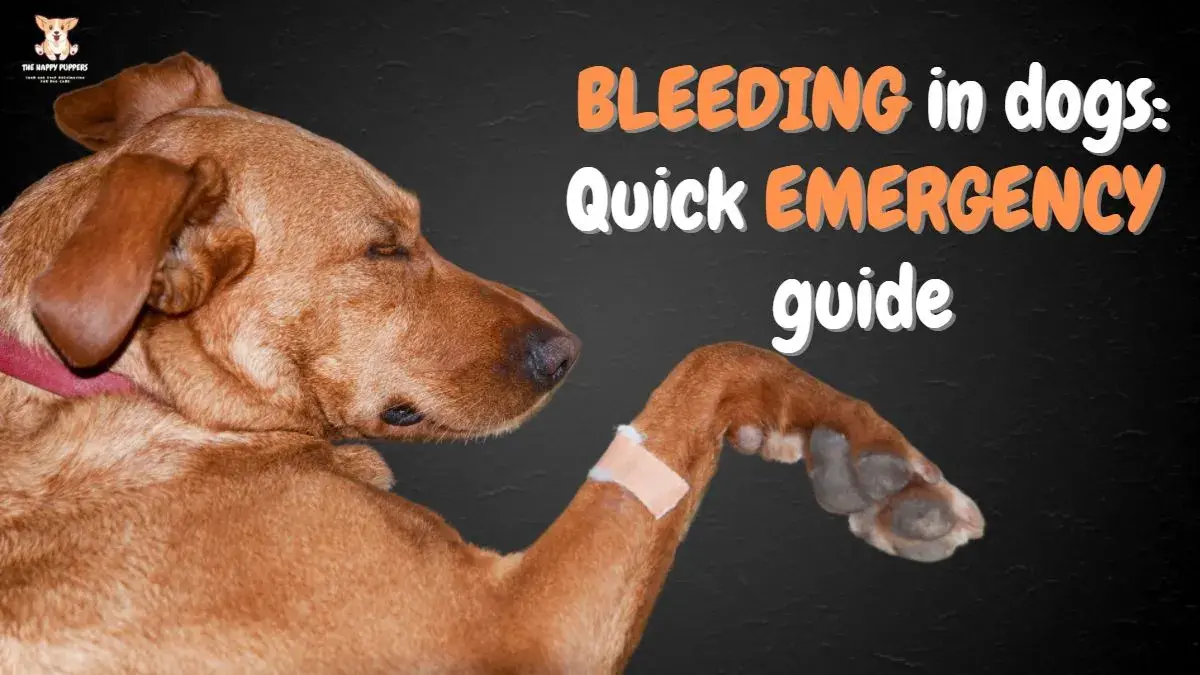
How to quickly and precisely reduce bleeding in dogs in case of an emergency?
Dogs play rough. I am yet to see a dog who prefers to sit and play with his siblings when healthy. Usually there is a lot of teeth and paws involved. Under such circumstances there are bound to be cuts and bruises resulting in bleeding. The dog’s legs and paws are vulnerable to injury from nails or other sharp objects, and they will heavily bleed if cut. Dog’s ears also bleed heavily when injured because the skin over the ear is very thin. Bleeding in dogs can be fatal if not brought under control soon.What do you do in such a situation? A dog can lose a lot of blood in a short time, which can cause shock (VCA). The primary signs of shock are:- white or pale gums
- rapid breathing or rapid heartbeat.
Topics covered in this blog post
Dog bleeding? Do this first
- Stay safe: even a gentle dog may bite when hurt. Keep your face away; use a muzzle only if your dog is not vomiting and is breathing normally.
- Press: put a clean cloth, towel or gauze on the wound and press firmly. Don’t lift it to check for at least 3 minutes (AVMA).
- Add, don’t remove: if blood soaks through, put another cloth on top and keep pressing.
- Call ahead and go: phone your vet or the nearest emergency clinic while someone keeps pressure on.
Never use hydrogen peroxide on the wound, and don’t give your dog human pain medicine.
Go to an emergency vet right away if
- blood is spurting or pulsing, or soaks through cloths quickly
- bleeding hasn’t stopped after 10–15 minutes of firm pressure
- your dog has pale or white gums, fast breathing, weakness or collapse (signs of shock)
- you hear a sucking sound from a chest wound, or something is stuck in the chest or belly (leave it in place)
- there is bleeding from the nose, mouth or bottom, blood in the urine, or your dog coughs up blood (possible internal bleeding)
On the way, keep your dog warm and as still and quiet as possible (AVMA).
Initial steps to stop the wound from bleeding
Apply a direct and gentle pressure on the wound
The first step to stop a bleeding is to apply direct pressure on the wound. For this purpose, place a clean cloth or gauze directly on your dog’s wound and press firmly. Don’t lift the cloth to check for at least 3 minutes, so a clot can form (AVMA). Once the blood has clotted, do not disturb the clot. If the bleeding is heavy or spurting, keep pressing and go straight to the nearest vet.If you observe blood soaking through the compress, do not remove the compress. Place a fresh compress or gauze on top of the old compress and proceed to apply pressure. If there is more than one injury, tie the compress with bandages. If you have nothing else, press firmly with your hand or fingers (gloves if you have them) until the bleeding slows.You must wash your hands before you tend to your dog and after handling body fluids like pus or blood. It is preferable to use gloves if available.Elevation
In case the wound is on a foot, paw or the leg is bleeding severely, raise the leg above the level of the heart, if your dog allows it. Doing this will allow gravity to minimize the flow of the blood near the wound which will reduce the bleeding and allow clot formation. Don’t lift a leg that looks broken or very painful; keep your dog lying flat and still instead (AVMA).Once you have elevated your dog’s leg, make sure you are applying direct pressure and compress on the wound for maximum effectiveness.Precautions you must take before you start to help your dog
There are certain precautions which must be followed before and while taking care of your dog.- Wash and sanitize your hands before you start to tend to the wounds of your dog.
- Muzzle your dog to protect yourself, unless your dog is vomiting or having trouble breathing (AVMA). In that case, have a second person gently hold your dog and keep your face away from the mouth. Your dog might have the sweetest temperament but when injured your pup is likely scared and in a lot of pain. There is a high chance that he or she might lash out. You cannot help your dog if you yourself are bitten. Thus, muzzling is important.
- Talk to your dog gently in a reassuring voice and if possible restrain him or her so that there is as little movement as possible.
- Again wash and sanitize your hands after you have tended to the wound of your dog.
Protocol to be followed to restrict bleeding from different parts of the dog
Procedure to stop bleeding from dog’s paws
Wrap the injured paw in a towel or a gauze and apply constant pressure. The bleeding should stop within 5 to 10 minutes. If the bleeding is occurring due to a broken nail, you can apply a silver nitrate stick or some cauterizing powder on the nail. In case silver nitrate or cauterizing powder is not available at your home, use baking powder or flour and cover up the injured nail with either of these. Keep the foot wrapped in a towel until you can get to your veterinarian.In case the foot is bleeding due to a torn foot pad or a deep cut, thoroughly check the foot for any kind of foreign object or debris. If a small piece of glass or a thorn is sitting near the surface and you can grasp it easily with tweezers, gently remove it. Rinsing the paw under gently running water can help wash out tiny bits. If anything is lodged deep, leave it alone: digging makes the bleeding and pain worse. Your vet can remove it safely, with sedation if needed (VCA).To stop the bleeding, apply pressure on the wound with a clean towel or gauze. Small cuts will stop bleeding soon. However, if you cannot stop the bleeding within 15 minutes, take your dog to the emergency vet clinic as soon as possible.Procedure to stop the bleeding from dog’s leg
In case, the cut is minor, check the leg for the presence of any foreign body lodged in them. Remove it only if you can easily reach it; leave anything deeply embedded for your vet. Flush the wound with water, remove the small debris and cover the wound with a clean gauze or towel. Preferably tape the gauze around the leg until you can reach your vet’s office.To treat a major cut, apply firm pressure on the same with a clean towel. Keep the leg elevated, preferably above the level of the heart to slow down the blood flow to the leg. As mentioned above, if the towel becomes soaked, do not remove the towel. Just place another clean towel on top of the soaked one.Procedure to stop the bleeding from dog’s torso
In case the cut happens on the torso (abdominal wall or chest), it will be difficult to keep the towel in place. Under such circumstances, you may need to tape the towel to keep in place. For this, wrap the towel with 3 to 4 layers of tape. Make sure to not tape the towel too tightly as it can restrict breathing, Use a hand towel, if your dog is of a small breed and a bath towel, if you have a large breed dog.In case you hear your dog make sucking noises while breathing, keep the towel in place and immediately proceed to the emergency clinic. Some chest injuries may involve the lungs and can be potentially fatal. In case you notice an object protruding from the chest or abdomen, do not try to remove it. Instead, wrap the towel around the foreign object without disturbing it and immediately proceed to your vet.Procedure to stop the bleeding from dog’s ears
Ears tend to bleed heavily as there are a lot of blood vessels on the ear flap. Also, the habit of vigorous head shaking in dogs makes this situation a lot worse. Thus, even in case of a minor wound you may find profuse bleeding from your dog’s ear.Put a small towel or gauze on both sides of your dog’s ear. Following this, fold the ear over the top of your dog’s head. Secure the towel in place by wrapping it with a tape. Make sure that there is a space of two fingers in between the neck and the bandage so that your pup’s breathing does not become restricted in any manner.What to do in case your dog is bleeding internally?
External bleeding can easily be detected while internal bleeding is not as easy. Internal bleeding can happen if your dog suffered an injury to one of his vital organs. However, there are ways in which you can detect if your dog has any internal bleeding.- Pale or white gums
- Weakness, collapse, or a weak and rapid pulse
- Fast, shallow or labored breathing
- A swollen belly
- Bleeding from the nose, mouth or bottom, bloody urine, or coughing up blood
Conclusion
Buy and store the following things at your home so that you can take immediate care of your pup in emergency situations:- Stack of gauze
- Fresh towels
- Antiseptic solution for dogs.
- Tape for securing purposes.
- Saline solution for flushing wounds (contact-lens saline works)
- Styptic powder or a styptic pencil for nails (cornstarch or flour in a pinch)
- A basket muzzle and disposable gloves
- Your vet’s and the nearest 24-hour emergency clinic’s phone numbers
Don’t use hydrogen peroxide on wounds (AVMA).
Have you ever had to face such a situation? What did you do under such circumstances? Do you have any tips on stopping dog blood loss? If yes, kindly put it in the comments for all dog guardians to know.Thank you for reading my post. I would be grateful if you can share this information with other dog guardians. Every dog guardian must be aware of emergency first aid procedures to be followed in case of bleeding in dogs.Press a clean cloth on the paw for 5–10 minutes. Then dab styptic powder or a styptic pencil on the nail tip; cornstarch, flour or baking powder work if you have nothing else. If it keeps bleeding or the nail is badly torn, see your vet.
Small cuts usually stop within a few minutes of firm pressure. Go to a vet if it hasn’t stopped after 10–15 minutes, or straight away if blood is spurting, the wound is large or deep, or your dog looks weak or has pale gums.
No. Hydrogen peroxide damages healing tissue. Flush small wounds with saline or clean water and let your vet advise on cleaning.
Pale gums, weakness or collapse, fast breathing, a weak and rapid pulse, a swollen belly, bleeding from the nose, mouth or bottom, blood in the urine or coughing up blood. This is an emergency: keep your dog warm and quiet and go to the vet immediately.
The ear flap has many blood vessels close to the surface, and head shaking reopens the wound. Put gauze on both sides of the flap, fold it over the head and tape it loosely (two fingers should fit under the tape at the neck), then see your vet.
