
Last Updated on: Nov 24, 2025
Should dogs wear clothes? While some people say that the dog’s own fur coat is enough to provide protection from all the harsh elements of nature, others are of the opinion that dogs need protection too and it is alright to make them wear clothes. In reality, whether should dogs wear clothes or not is completely dependent on the dog, their fur conditions, the weather, and a few more factors, which I will discuss further in this blog post.
In winter, it is very common to see pups parading around in coats and sweaters. Some may even have dog booties on. Though they look super cute and fashionable all dressed up, is it necessary? Or are we doing it to satisfy our psychological need to protect our baby?
Topics covered in this blog post
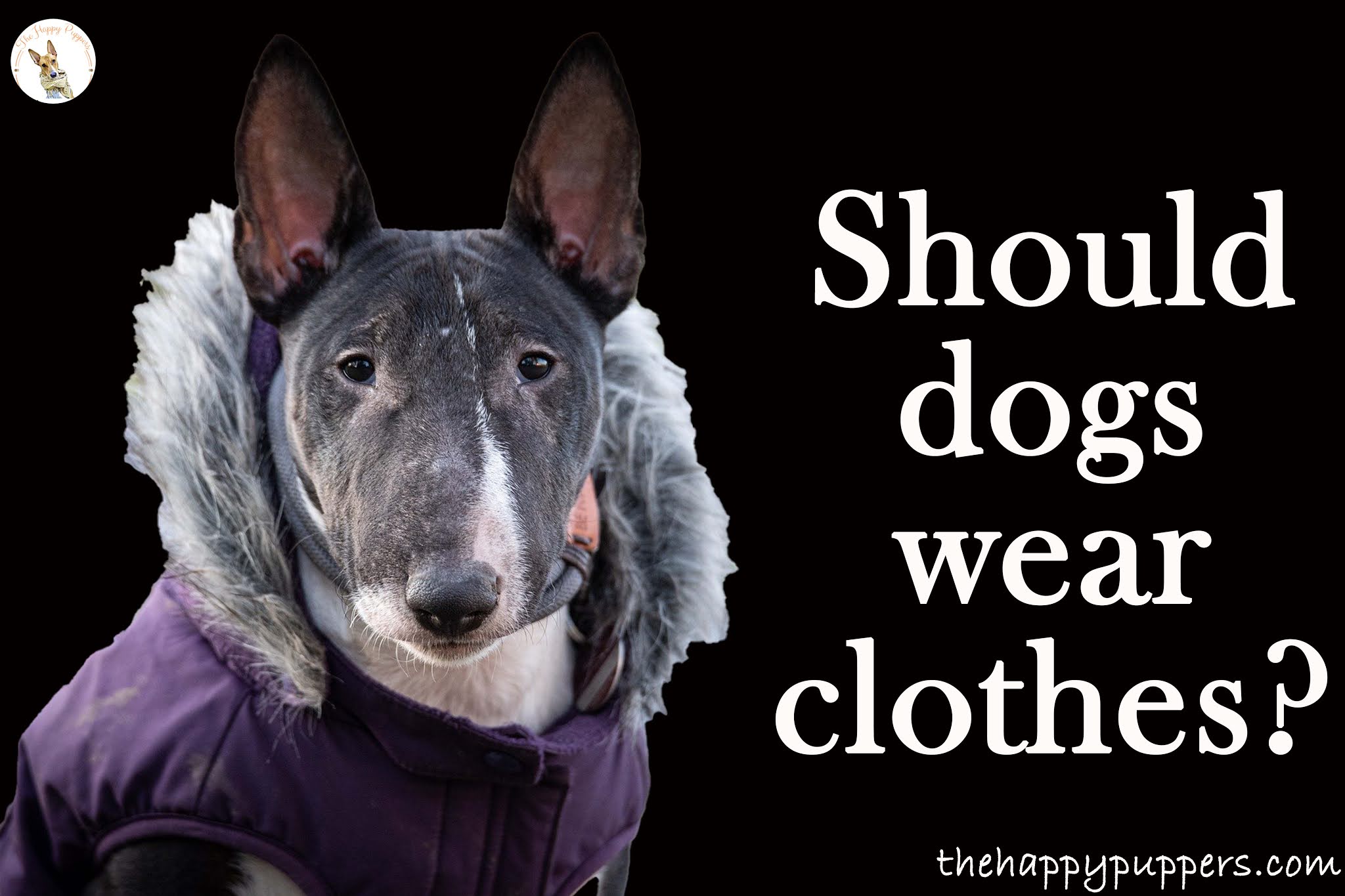
Should dogs wear clothes?
So, what to BELIEVE in? Should dogs wear clothes or NOT? The answer to this question depends on multiple factors. Keep reading to find out whether or not YOUR DOG should wear clothes?
How warm your dog can keep himself depends on several factors:
- Breed and Fur coat type
- Size
- Age and disease
Breed and fur coat type:
Protection from the elements of nature depends on your skin type. If you have thin skin, you will get sunburnt quickly than someone who has thicker skin. Some people are more prone to getting tanned compared to others. Similarly, for dogs, protection from cold depends on the fur coat they have.
Thus, to understand whether or not your dog needs to wear clothes, you need to know what kind of coat your dog has been blessed with.
Dogs that most frequently struggle in colder temperatures are small dogs, especially toy breeds, and dogs without thick fur. Lean dogs with short fur, such as Azawakhs, Whippets, and Greyhounds, also frequently benefit from sweaters during cold weather since they don’t have a lot of fur or body fat to insulate them.
AKC Expert Advice
Let’s have a look at the types of fur coats in a dog’s body:
Undercoat: This coat lies closest to the skin of the dog and grows from a single follicle in a clustered manner. The undercoat is responsible for protection from the cold.
Guard hair: Guard hair is harder in texture and acts as the primary fur coat. They protect the skin from injuries and provide an additional layer of insulation.
If your dog is blessed with a thick undercoat and an outer primary coat, then your dog has a double coat e.g. Siberian Husky, Alaskan Malamute, Saint Bernard, etc. He/she can enjoy the cold weather without a jacket. If you make such dogs wear clothes, they might feel really uncomfortable and hot. They are genetically endowed with fur designed to protect them in extremely low temperatures.
However, if your dog has only one fur coat with no undercoat or a very thin undercoat (like in case of terriers, pinschers, chihuahuas, etc., then your pooch is likely to feel cold in winters and will need a sweater or jacket to keep warm. They have not been genetically designed to survive in very cold weather conditions. Such dogs are said to have a silky coat.
Hairless breeds, such as the Chinese Crested or Xoloitzcuintli, have even less natural protection and often require clothing for warmth and sun protection to prevent skin issues. According to the American Kennel Club (AKC), breeds like Whippets and Greyhounds, with their lean builds and short fur, lose body heat quickly and benefit from sweaters in cooler weather, while thick-coated breeds like Newfoundlands are naturally insulated for harsh conditions (AKC, 2024).
Breeds like poodles are blessed with thick hair, but the hair is generally kept short to avoid matting. Such breeds need a sweater to keep them warm in winters. For breeds with thin or light-colored coats, sun-protective shirts with UPF 50+ ratings can shield against UV rays during outdoor time, reducing the risk of sunburn or skin damage (AKC Pet Insurance, 2022).
| Coat Type | Example Breeds | Natural Insulation | Clothing Recommendations | When to Use Clothes | Risks of Over-Dressing |
|---|---|---|---|---|---|
| Double-Coated | Siberian Husky, Alaskan Malamute, Saint Bernard, Labrador Retriever, Shiba Inu, Newfoundland | Excellent – Dense undercoat for warmth in cold; topcoat repels water and dirt. Handles extreme cold well but sheds heavily. | Rarely needed; their fur provides sufficient protection. | Only in extremely cold conditions, for seniors/ill dogs, or post-surgery to protect skin. | Can cause overheating, discomfort, or matting of undercoat; avoid in mild weather as it traps heat. |
| Single-Coated | Chihuahua, Whippet, Greyhound, Yorkshire Terrier (silky), Poodle (curly but single layer), Smooth-Coated Terriers, Italian Greyhound | Limited – Single layer offers less warmth; better for warmer climates but prone to chills in cold. Body temperature drops faster in cold compared to double-coated breeds. | Often recommended; sweaters, jackets, or booties for cold weather to prevent shivering and health issues. | In winter, indoors with low heat, for small/thin breeds, puppies, seniors, or those with health conditions like hypothyroidism. | Minimal if fitted properly, but watch for overheating in warm weather or during activity; ensure breathable materials. |
| Hairless (Subset of Single-Coated) | Chinese Crested, Xoloitzcuintli | None – Exposed skin vulnerable to cold, sun, and injuries. | Essential; protective clothing like sweaters for warmth and UV shirts for sun exposure. | Year-round for temperature regulation, allergy protection, or outdoor activities. | Skin irritation if material is rough; always use soft, fitted options and monitor for allergies. |
Size:
Small breed dogs have generally been observed to feel colder than the large breed ones. This is because small and toy breeds, like Chihuahuas or Italian Greyhounds, have a higher surface-area-to-body-mass ratio, causing them to lose heat faster. Vets note that these pups may shiver even in mild chills, making lightweight sweaters a practical choice for their comfort and health.
Age and disease:
- An elderly dog
- Your dog has a weak immune system
- Your dog is suffering from diseases that cause impairment in hair growth (e.g. hypothyroidism or Cushing’s disease)
For instance, dogs with Cushing’s disease often experience fur loss, making them more vulnerable to temperature changes—clothing can help regulate their body heat and protect exposed skin. Senior dogs with arthritis may find that joint pain worsens in cold weather, but a cozy coat can reduce stiffness and improve mobility, as supported by veterinary advice. (PrideBites)
Should Dogs wear clothes? When the answer is YES
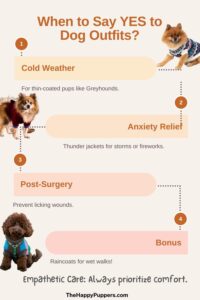
Cold weather:
Most people say dogs are already endowed with a coat. Why bother covering them up even if it is cold outside? Their fur is enough protection for them. This may be right for some dog breeds. However, this generalized theory cannot be applied everywhere.
Saint Bernards will never need to wear clothes as they have a thick double coat. Such dogs are bred to survive in extremely cold weather conditions. Such dogs don’t need clothes.
On the other hand, let’s look at Whippets. Whippets have very thin fur, and they contain very little body fat. You cannot expect a Whippet to survive in severe weather conditions if you do not put a doggie jacket or sweater on the pup.
In addition to jackets, booties can protect paws from ice, salt, or hot pavement, especially for breeds like Greyhounds with sensitive paws. The AKC recommends these for dogs in extreme weather to prevent injuries or frostbite.
Furthermore, if you have a senior dog or a dog who is suffering from an underlying medical condition, in such cases, dogs wearing clothes is a better option for their own safety.
Puppy wearing clothes
Puppies born during the months of winter face struggles due to the cold weather. Puppies wearing clothes should be encouraged to keep them warm and to shield them from the outside environment. They do not have the ability to regulate their body temperature yet, so putting clothes on them helps a lot.
For nervous dogs:
Dogs who get scared when there is a loud noise, like firecrackers or during thunderstorms, can definitely benefit from wearing clothes. For such dogs, normal dog clothes won’t suffice. For such pups, it is best if you make them wear either a tight-fitting dog shirt or a thunder jacket. These clothes are tight and provide a hug-like feeling to your dog. This type of snuggly pressure creates a calming environment for the dog, allowing him or her to calm down and feel less anxious and stressed.
Items like thundershirts apply gentle pressure to mimic a hug, which can reduce anxiety during storms or fireworks, but they’re not a cure-all—introduce them slowly with treats to build positive associations. Vet charities like PDSA emphasize monitoring for stress signs like panting or yawning (PDSA, 2022).
If you have a nervous dog, it may respond well to a Thundershirt or a tighter fitting sweater or doggy t-shirt. The ‘snuggly’ pressure created has often been shown to have a calming effect.
Gemma Johnstone, dog expert at The Spruce Pets,
Postoperative care, or if the dog is ill
Dogs wearing clothes is a great option post-operation. Dogs tend to keep licking the area where the sutures from the operation are. Hence, it is a better idea to have these dogs wear clothes so there are fewer chances of the dog being able to reach the suture and disturb the site of operation.
If your dog suffers from a pollen allergy or any other skin condition, it is best to make your dog wear clothes. Wearing a T-shirt will keep the skin covered and prevent the skin from coming in contact with the allergens. Clothes can also keep your dog from scratching itself too much. Please remember that just wearing a t-shirt will not make the allergy go away.
For skin allergies or post-surgery, t-shirts or coveralls prevent licking and protect against irritants, but always consult your vet first to ensure it aids healing without causing overheating (The Spruce Pets)
For special occasions or photo shoots
If it is a special occasion like Valentine’s Day, New Year’s, Christmas or Halloween, and you want to have a photo shoot with your pup, making your dog wear clothes is perfectly okay as long as the dress is made of breathable material and does not bother your pup.
For breeds like Pugs or Bulldogs with breathing issues, avoid face-covering costumes to prevent overheating or restriction—opt for simple capes instead. Keep sessions short and supervised to ensure your pup stays happy (The Dog People).
Age
If you have a senior dog, he or she may be suffering from a medical issue that may cause a lowering of the body temperature. Furthermore, diseases like arthritis tend to cause more problems in cold weather. Therefore, putting a dog coat on your dog can help keep him or her snuggling winters and keep that arthritis pain at bay. Raincoats for dogs and also available which can be used using the rainy weather to keep your dog protected from the rain.
Should dogs wear clothes to keep themselves clean?
The last point in favor of dogs wearing clothes is cleanliness. Making your dog wear a T-shirt will help him or her stay cleaner when spending time outside the house. Less dirt means that you are required to give him or her less number of baths as well. Clothes also ensure that your dog brings in the least amount of the outdoor environment with him or her when they come back into the house.
=”_blank” rel=”noopener”>>Puppies have small legs and tend to be closer to the ground compared to adult dogs of the same breed. If the puppy wears clothes and roams around, chances are he or she will be less dirty. Hence, this is another point in favor of puppy wearing clothes. Clothes can also guard against =”https://thehappypuppers.com/dog-health/tick-bites-in-dogs/” target=”_blank” rel=”noopener”>ticks, fleas, or UV rays during outdoor adventures, keeping your dog’s skin safe while reducing shedding in the home—washable t-shirts make maintenance easy.
How to identify if my dog needs a sweater?
Dogs cannot communicate the way humans can. Thus, we need to keep a watchful eye on their behavior so that we can understand when they need what.
If your baby is happy to stay out in the cold or snowy weather, you don’t need to worry about them feeling cold. However, if your fur baby shows reluctance in going out for walks, play, or just to relieve themselves, put a sweater on them. With the sweater, if they are ready to go out and play, then you have your answer.
Also, some short fur coat breeds may even feel cold while indoors if the heating is low or absent. If you find your pooch curled up in a corner and reluctant to move around in the house, put a warm blanket on him/her. If at some time, you see your baby lying in a more relaxed position, then you know that your baby needs a light sweater even in the house. Look for signs like shivering, reluctance to move, or seeking warm spots—these indicate your dog might need extra insulation, especially in breeds without thick fur.
Clothing is not a necessity for every pet, but some animals benefit from a little extra protection during cold or damp days.
Westfield Vet Hospital
Should dogs wear clothes? When the answer is NO
Your dog is unhappy or fearful
If your dog does not want to wear clothes, or is looking scared or unhappy, don’t force your dog to wear clothes if there is no need. If your dog is comfortable without clothes, let him be. If, despite this, you force your dog to wear clothes, you will be doing it for yourself, not for your dog.
The outfit is not comfortable or ill-fitting
<p&amp;amp;amp;amp;amp;amp;gt;Whatever you plan to make your dog wear, first make sure that your dog will be comfortable in it. The primary objective of the guardian should be to keep the pup comfortable. The t-shirt or coat you put on your dog should not get entangled around the legs.
If you are thinking of dressing your dog up in a novelty outfit, make sure that the dress is not too heavy or cumbersome for your pup. It should also not interfere with your pup’s vision or freedom of movement. The clothing should not overheat your dog either. Furthermore, do not leave it on your dog for too long, and do not leave your pup unsupervised. Watch for overheating signs like panting, and ensure a snug but not tight fit—measure neck, chest, and length to avoid rubbing or restriction (Westfield Vet Hospital).
Get the dog used to wearing clothes:
The dog must be used to wearing clothes. For example, if the pup is feeling cold and needs to wear a coat to keep warm. Your pup must be allowed to get used to it first. Place the coat within the view of dog, where they can easily smell it and check it out. Give your dog a ton of treats so that he associates the coat with lots of tasty treats.
With every session, bring the coat closer to your dog while ensuring that they are given plenty of positive reinforcements. Gradually touch the coast to your dog. When your pup is comfortable with all the above steps, start to put the coat on your dog for short durations.
If at any point your dog starts to get uncomfortable, remove the coat. Go back a step and start again. Your goal should be that your dog associates the coat with something positive and not something that he or she is forced to wear.
If discomfort arises, pause and retry later—positive reinforcement helps your dog see clothes as a treat-associated comfort, not a force.
Personal experience:
My boys, Alpha and Delta, are both rescue pups (you can read their story here). They were both born in winter and were severely susceptible to the cold. I would have the heater switched on in the room 24/7. They would lounge in front of it on their blankets, wearing sweaters and completely curled up. Can you imagine the cold they felt?
If the heater was off, Alpha would shiver, bury himself under blankets, while Delta would have water dripping from his nose.
Well, Delta is 7 years old now. However, in winter, he still needs to wear two sweaters before going out for his walks. Indoors, he prefers to wear a thick t-shirt and still sleeps on top and under the blankets whenever possible. In summer, if the air conditioner is on, Delta needs a light t-shirt to keep him comfortable. Thus, he needs to wear clothes like us, humans..!!
Does your dog need clothes? Find out here
Conclusion:
Let me know your thoughts in the comments below: What breed is your furry friend, and do they rock outfits or prefer going au naturel? Share your experiences—does dressing them up help with cold weather, anxiety, cleanliness, or just for those adorable photo ops? I’d love to hear if you’d like a follow-up post on breed-specific clothing reviews, like which pups thrive in sweaters and which ones are better off without!
Curious if your dog actually needs clothes? Take our quick quiz below to assess based on breed, age, health, and more—it’ll give you personalized insights in just a minute! [Quiz Link: https://thehappypuppers.com/quiz/does-your-dog-need-clothes]
If this guide sparked more questions about dog care, training, psychology, or health, subscribe below to get science-backed tips and updates straight to your inbox the moment a new post drops. For even more paws-on content, like training demos, health Q&As, real-life stories with my rescue boys Delta, Zeus, and Alpha, and fun doggo adventures, subscribe to our YouTube channel at Shruti and Delta, and let’s make every tail wag!
Thanks for reading, fellow dog guardians—keep up the amazing work with your fur babies. Wags and woofs until next time! 🐶
See you in my next post
Frequently asked questions
No, if the dog needs clothes like during cold climate or if the dog is facing medical conditions like arthritis, then making him or her wear clothes is beneficial. However, if the pup is uncomfortable in the clothes and is forced to wear them, this would be cruelty.
If your dog belongs to the breeds who are endowed with double fur coat, it will be cruel to dress up your dog since these dogs don’t need to be clothes at all.
Dogs do not prefer to be dressed up. However, if the dress makes them comfortable, their is a chance that over time the dog may find more comfort in staying dressed up. Therefore, in such condition, the dog may like being dressed up.
If it is needed like during cold weather and in case your pet has thin fur layer, then yes! pets must wear clothes.
Yes, for paw protection from hot pavement, ice, or thorns—especially for active or sensitive breeds. The AKC suggests non-slip options for seniors.
About the Author
Dr. Shruti Bhattacharya is the founder and guiding force behind The Happy Puppers, combining a Ph.D. in Immunology with decades of direct canine care experience. Her passion for the well-being of dogs has taken many forms:
- Academic & Scientific Rigor – Dr. Shruti applies a science-based approach to pet care, enriched by her training in immunology.
- Hands-On Street Work – Over the past 10+ years, she has personally cared for 30+ street dogs, tending to their health, training, and rehabilitation, even as she relocated and continued caregiving with 15 dogs, and currently supports 5 local neighborhood dogs outside her apartment.
- Instinctual Bond with Dogs – From stray pups to fostered companions, even strangers recognize her as a safe and trusted friend to dogs—drawn to her calm presence and empathy.
- Personal Pack – She’s the proud canine mom of Delta, a German Shepherd–Pitbull mix; Zeus, an energetic Labrador mix; and Alpha, a curious Indian pariah pup—each inspiring her mission through their daily lives.
Through The Happy Puppers, Dr. Shruti shares science-backed advice, empathetic insight, and evidence-based tips designed to empower dog guardians worldwide. The purpose of this is to blend real-world experience with academic expertise, helping every dog feel safe, loved, and thriving.

Follow me on:
Disclaimer
This content is for informational purposes only and not a substitute for professional veterinary or grooming advice. Consult a veterinarian for specific dietary concerns.
References
- PrideBites. 5 reasons why dog clothes are important.
- Rowlands, R. Do dogs need clothes? AKC Pet Insurance.
- PDSA. 2022. Is it ok to dress up my pet? 2025
- The Spruce Pets. Is it OK to dress up your dog?
- Westfield Vet Hospital. Pet clothes: A fashion statement or a necessity?
- Rover.com. Should you dress up your dog with a costume?
- American Kennel Club (AKC). Sweaters for dogs.
