


Topics covered in this blog post
Why does your training style matter for your dog’s future behavior?
 |
| Dogs are highly intelligent creatures |
That the dog is a loyal, true and affectionate friend must be gratefully admitted but when we come toconsider the psychical nature of the animal, the limits of our knowledge are almost immediately reached.
Behavior concerns can affect welfare and contribute to relinquishment. Avoid quoting an unsourced universal euthanasia proportion; early veterinary assessment and qualified reward-based behavior support can help.
Every dog is trainable:
I have read in a ton of Facebook groups and online forums that dogs belonging to certain breeds are untrainable. I have probably heard this most about Afgan hounds, Basenji, Beagle, Indian Pariah dogs and so many more.
First of all, let me make one point very clear. No dog is untrainable. Every dog can be trained. However, it is up to the guardian or trainer to find out what makes the dog tick. We need to understand that every dog is different and responds to the same stimuli in a different manner. Just the way that people belonging to different countries have different attitudes, but that does not mean that people belonging to a specific country cannot learn a new skill when taught. Similarly, every dog can be trained. Some are easily trainable while others need a little more coaxing and patience.
I am currently working with 9 dogs who live in my locality. They are all Indian Pariahs. Each of them has their own unique personas, so different yet so similar. I will be describing each of their personalities and how to train dogs with such personalities in my next blog post.
The situation with Delta:
I am the sole trainer of my boy Delta. Since I rescued him, I don’t have an accurate idea of his breed. However, by his looks and behavior, he seems to be a Basenji mix. He has a very defined personality. He does not like to do things until he sees himself receiving a reward in return.
Normally, people would say this is a stubborn and untrainable dog. However, I say that such dogs are more intelligent. They like to question everything they are asked to do. They would do it only if they feel it’s worth their effort. This is a sign of higher-level intelligence.
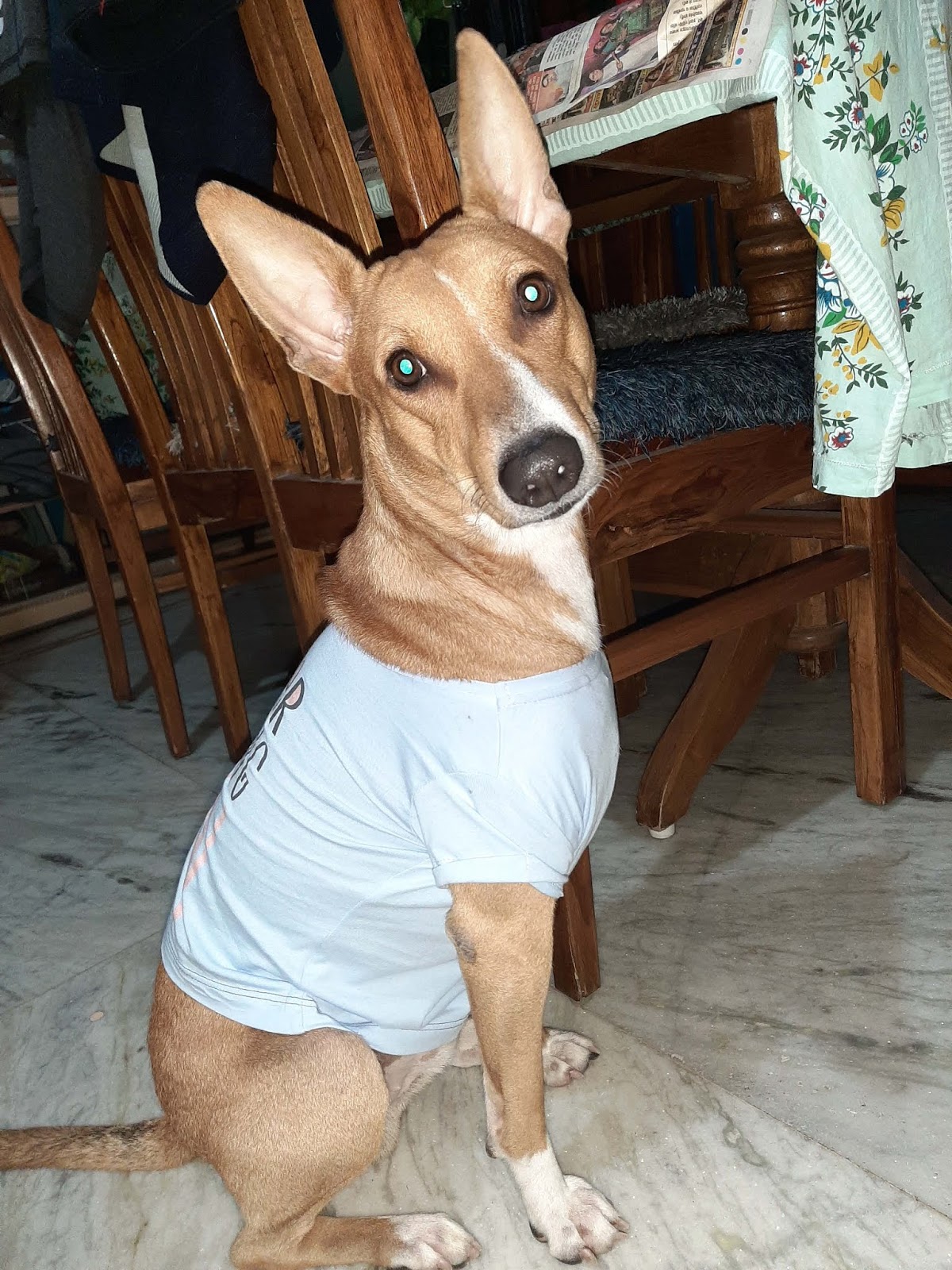 |
| Delta is highly intelligent and food-driven |
If other dogs can be trained to follow a specific command in one day, Delta will need training for 3 days to follow the same command unconditionally. On the other hand, with other dogs, I can only expect them to understand and learn one new command at one go, while Delta can learn up to 3 commands at once.
Delta is also moody, so I must judge his mood before starting his training. To train dogs like Delta, respect, patience and understanding of their behavior is needed. If you understand your dog, training is a piece of cake. Unfortunately, most people who return their dogs to the shelter due to behavioral
issues either fail to understand their dog’s personality and behavior or do not dedicate ample time to work and mold that behavior to suit their needs.
In this article, I aim to discuss a recent study which has made an attempt towards understanding the
association between psychological status and personality of the dog guardian and the presence of
behavioral problems in their dogs.
What has been observed so far in relation to dog behavior?
A study done in 1995 in Cambridge University found that dogs who had guardians expressing higher
levels of neuroticism (worry, depression, loneliness, jealousy, anger, frustration etc) were observed to show higher levels of behavioral problems like destructiveness, aggression, sexual mounting and
attention-seeking behavior.
Pin this article for later:
 |
| How training affects your dog |
Some studies have found links between an owner’s personality or mood and their dog’s behavior, but these links don’t show that one causes the other. These associations do not establish that a guardian’s mental health causes aggression.
What was done in this particular study?
This study was conducted at the Center for Canine Behavior Studies, Salisbury, CT, the United States of America. As a part of this study, 1564 surveys of dog guardians were conducted. The scientists used questionnaires to assess the personality of the dog guardians.
The surveys were designed to measure the following:
- The personality of the dog guardians (depression levels, emotional regulation).
- Use of aversive training methods.
What are aversive training methods:
- Owner directed aggression
- Separation problems
- Persistent barking
- House soiling (pooping and peeing when left alone)
- Stranger directed aggression
- Chasing
What was the conclusion of the study?
Thus the bottom line of this study is that positive reinforcement is the only way to go when it comes to properly train your dogs.
Use short, enjoyable sessions and practise gradually in different settings. Progress varies; neither a week of repetition nor any training method guarantees perfect responses.
For adult dogs, tailor rewards, session length and difficulty to the individual. End before fatigue or frustration and seek help when fear, pain or anxiety interferes with learning. Do not expect responses while asleep.
Practise familiar cues in varied safe settings, increasing distractions gradually and rewarding success. Let resting dogs sleep; use a leash and secure spaces rather than relying on unconditional obedience.
Conclusion:
Dogs are love-hungry creatures. They will do anything to please you if you have their respect and love.
A dog’s behavior reflects genetics, health, learning history and environment as well as current circumstances. Being shy, sad or depressed does not mean a guardian will make a dog aggressive. Choose reward-based training and seek veterinary help for concerning changes.
Your dog will learn from you, so be a good role model for your pup.
PS: If you like this article, please share it with your friends and leave a comment. Let’s help dog guardians everywhere become a better version of themselves.
