


If your dog just ate chocolate: take the wrapper away, note your dog’s weight and the time, and call your vet or an emergency clinic now. In the US you can also call the ASPCA Animal Poison Control Center at (888) 426-4435 or the Pet Poison Helpline at (855) 764-7661. Both are open 24/7 and charge a fee (see the FAQ). Don’t wait for symptoms.
Chocolate is easy for dogs to find, especially around Halloween, Christmas, Valentine’s Day and Easter, when there’s more of it lying around the house. How serious it is depends on the type of chocolate, how much your dog ate and how big your dog is, and dark and baking chocolate are the most dangerous (ASPCA; Pet Poison Helpline).
In this post I’ll walk you through what to do, how much is too much, and what your vet will do.
Topics covered in this blog post
Why is chocolate toxic to dogs?
Chocolate contains two stimulants called methylxanthines: theobromine and caffeine. Dogs break down theobromine very slowly. Its half-life in dogs is about 17.5 hours (caffeine’s is about 4.5 hours), so it stays in the body for a long time and keeps stimulating the heart and nervous system (Merck Veterinary Manual).
The high fat content of chocolate products can also trigger pancreatitis in susceptible dogs (Merck Veterinary Manual).
How much chocolate is toxic to a dog?
It depends on three things: the type of chocolate, how much, and your dog’s weight. The darker and more bitter the chocolate, the more dangerous it is.
Theobromine + caffeine content by chocolate type
| Type of chocolate | Methylxanthines per ounce | Risk |
|---|---|---|
| Cocoa powder (dry, unsweetened) | about 807 mg/oz | Highest |
| Unsweetened baking chocolate | about 440 mg/oz | Very high |
| Semisweet / sweet dark chocolate | 150–160 mg/oz | High |
| Milk chocolate | about 64 mg/oz | Moderate |
| Cocoa bean hull mulch | about 255 mg/oz | High (some brands are treated) |
| White chocolate | about 1.1 mg/oz | Negligible toxin (but fatty) |
Source: Merck Veterinary Manual, “Chocolate Toxicosis in Animals” (2024 review, updated 2026).
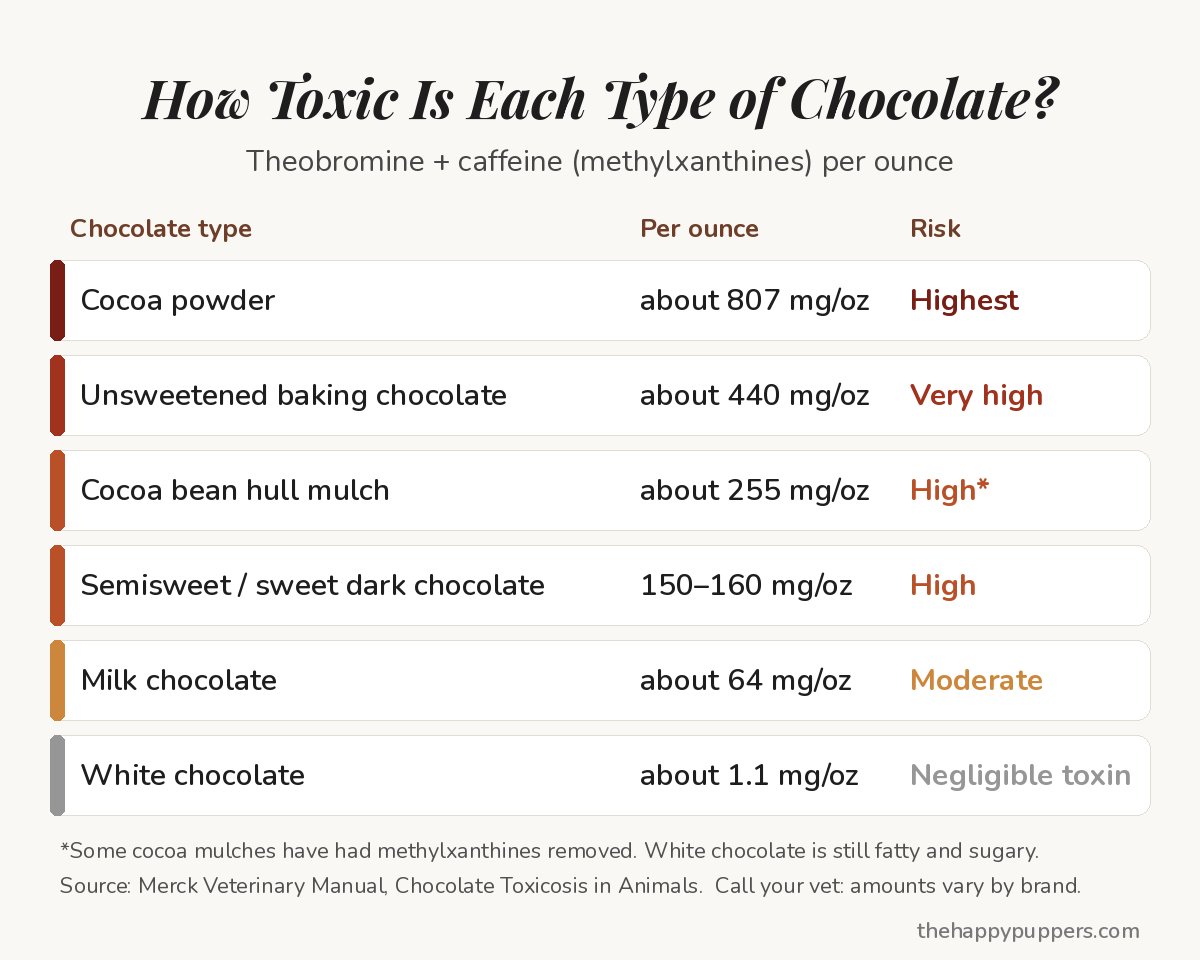
Tip: the % cocoa on a bar tells you roughly how much is unsweetened chocolate. A 70% bar is closer to baking chocolate than to milk chocolate (Merck Veterinary Manual).
Doses that cause problems
The Merck Veterinary Manual gives these general thresholds (per kilogram of body weight; 1 kg = 2.2 lb):
- 20 mg/kg: mild signs (vomiting, diarrhea, increased thirst)
- 40–50 mg/kg: effects on the heart
- 60 mg/kg or more: seizures
Individual dogs vary, and some react at lower doses. For milk chocolate, about 1 ounce per pound of body weight is potentially lethal.
What that means in real life (worked examples)
These are rough calculations from the Merck figures above, not a reason to wait at home:
- A 10 lb (4.5 kg) dog reaches the 20 mg/kg “mild signs” level at about 90 mg of methylxanthines. That’s roughly 1.4 oz of milk chocolate, or a little over half an ounce of dark chocolate, or about 0.2 oz of baking chocolate.
- A 50 lb (22.7 kg) dog reaches the same level at about 454 mg. That’s roughly 7 oz of milk chocolate or 3 oz of dark chocolate, but only about 1 oz of baking chocolate.
Because amounts vary by brand, always call with the wrapper in hand and let the vet or poison line do the math.
What to do if your dog ate chocolate: the first hour
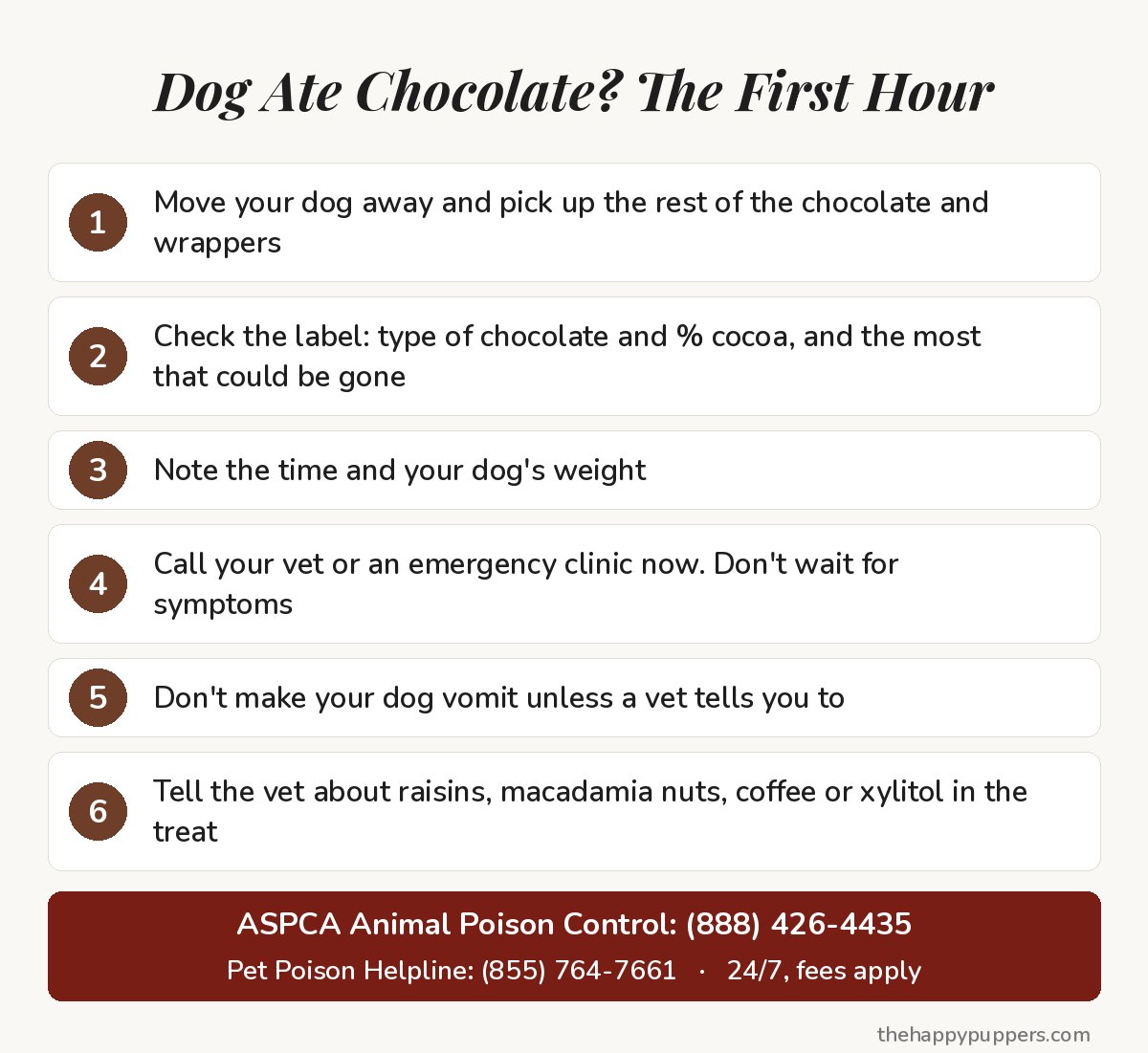
- Move your dog away and pick up any remaining chocolate and the wrappers.
- Work out what was eaten: the type of chocolate (check the label and % cocoa), the most it could have been, and the time.
- Know your dog’s weight. A recent vet record or a quick bathroom-scale weigh-in is fine.
- Call your vet, an emergency clinic, or a poison line now:
- ASPCA Animal Poison Control Center: (888) 426-4435
- Pet Poison Helpline: (855) 764-7661
- Don’t make your dog vomit at home unless a vet tells you to. Whether to induce vomiting depends on how long ago the chocolate was eaten and whether your dog already has signs, and vets prioritize emetic drugs licensed for dogs (Merck Veterinary Manual).
- Check for other dangers in the treat. Chocolate candy and baked goods may also contain macadamia nuts, raisins or xylitol (Pet Poison Helpline), and coffee adds more caffeine (ASPCA). Tell the vet about every ingredient.
Symptoms of chocolate poisoning in dogs
Signs usually start 6 to 12 hours after eating chocolate and can last up to 72 hours in severe cases (Merck Veterinary Manual; AKC). Older dogs and dogs with heart conditions are at higher risk (AKC).
Early signs:
- Vomiting and diarrhea
- Drinking a lot, peeing more
- Restlessness, panting
- Bloated belly
Serious signs (emergency):
- Racing or irregular heartbeat
- Tremors, stiffness, wobbliness
- Seizures
- High body temperature
- Collapse
If you see any of the serious signs, go to the nearest emergency vet immediately.
When to call the vet
Call right away (don’t wait for symptoms) if:
- Your dog ate any baking chocolate, cocoa powder, or dark chocolate
- A small dog ate more than a nibble of milk chocolate
- You don’t know how much was eaten
- The treat also contained raisins, nuts, coffee or xylitol
- Your dog has a heart condition, seizures, or a history of pancreatitis
AKC notes that a crumb of chocolate cake or a very small piece of a chocolate bar is unlikely to be fatal, especially for a larger dog. It’s still worth a quick call to check.
How vets treat chocolate poisoning
According to the Merck Veterinary Manual, treatment depends on how much was eaten and how your dog is doing:
- Inducing vomiting, usually if the chocolate was eaten recently (often within about 2 hours) and the dog has no symptoms yet
- Activated charcoal, only in some cases, because it can cause sodium problems with chocolate
- IV fluids to support the heart and help flush out theobromine
- Medicines to control vomiting, tremors, seizures, or an abnormal heart rhythm
- Heart monitoring and temperature control
How to prevent it
- Keep chocolate, baking supplies and cocoa powder in closed cupboards, not on low tables or in handbags.
- Be extra careful during Halloween, Christmas, Valentine’s Day and Easter (candy bowls, advent calendars, Easter egg hunts, wrapped gifts under the tree). See our Halloween safety tips for dogs and Valentine’s Day ideas for dogs.
- Ask guests and kids not to share treats.
- Don’t use cocoa bean mulch in gardens your dog can reach.
- Teach a solid “leave it” cue.
- Dressing your dog up for Halloween? Check that the costume has no chewable bits; see our Halloween dog costume safety tips.
With our four dogs, the treat bowls always stay on a high shelf.
Frequently asked questions
Yes. Signs often take 6–12 hours to appear, and treatment works best before they start. A quick call tells you whether it’s a toxic dose.
It has almost no theobromine (about 1.1 mg/oz), so it’s unlikely to poison your dog. But it’s very fatty and sugary and can cause vomiting, diarrhea or pancreatitis. Still not a treat.
It depends on the type and your dog’s weight. Merck lists seizures at 60 mg/kg or more and about 1 oz of milk chocolate per pound of body weight as potentially lethal. Much smaller amounts of baking chocolate or cocoa powder are dangerous. Call rather than guess.
Not unless a vet tells you to. Merck notes that emetic drugs licensed for dogs should be prioritized, and inducing vomiting is only considered for dogs that are still normal and ate the chocolate recently.
Yes, in severe cases, usually from heart rhythm problems, overheating or breathing failure (Merck). Fast treatment makes this much less likely.
AKC suggests a dog-safe alternative such as a treat made with carob. For a fruity option, see can dogs eat strawberries.
No. The ASPCA Animal Poison Control Center says a consultation fee may apply, and the Pet Poison Helpline lists a $99 incident fee on its chocolate page (checked October 2026). Your vet or local emergency clinic is always an option too.
Sources
- Merck Veterinary Manual: Chocolate Toxicosis in Animals. https://www.merckvetmanual.com/toxicology/food-hazards/chocolate-toxicosis-in-animals
- AKC: What to Do if Your Dog Eats Chocolate. https://www.akc.org/expert-advice/health/dog-ate-chocolate/
- Pet Poison Helpline: Chocolate. https://www.petpoisonhelpline.com/poison/chocolate/
- ASPCA Animal Poison Control Center. https://www.aspca.org/pet-care/animal-poison-control
- ASPCA: People Foods to Avoid Feeding Your Pets. https://www.aspca.org/pet-care/aspca-poison-control/people-foods-avoid-feeding-your-pets
