

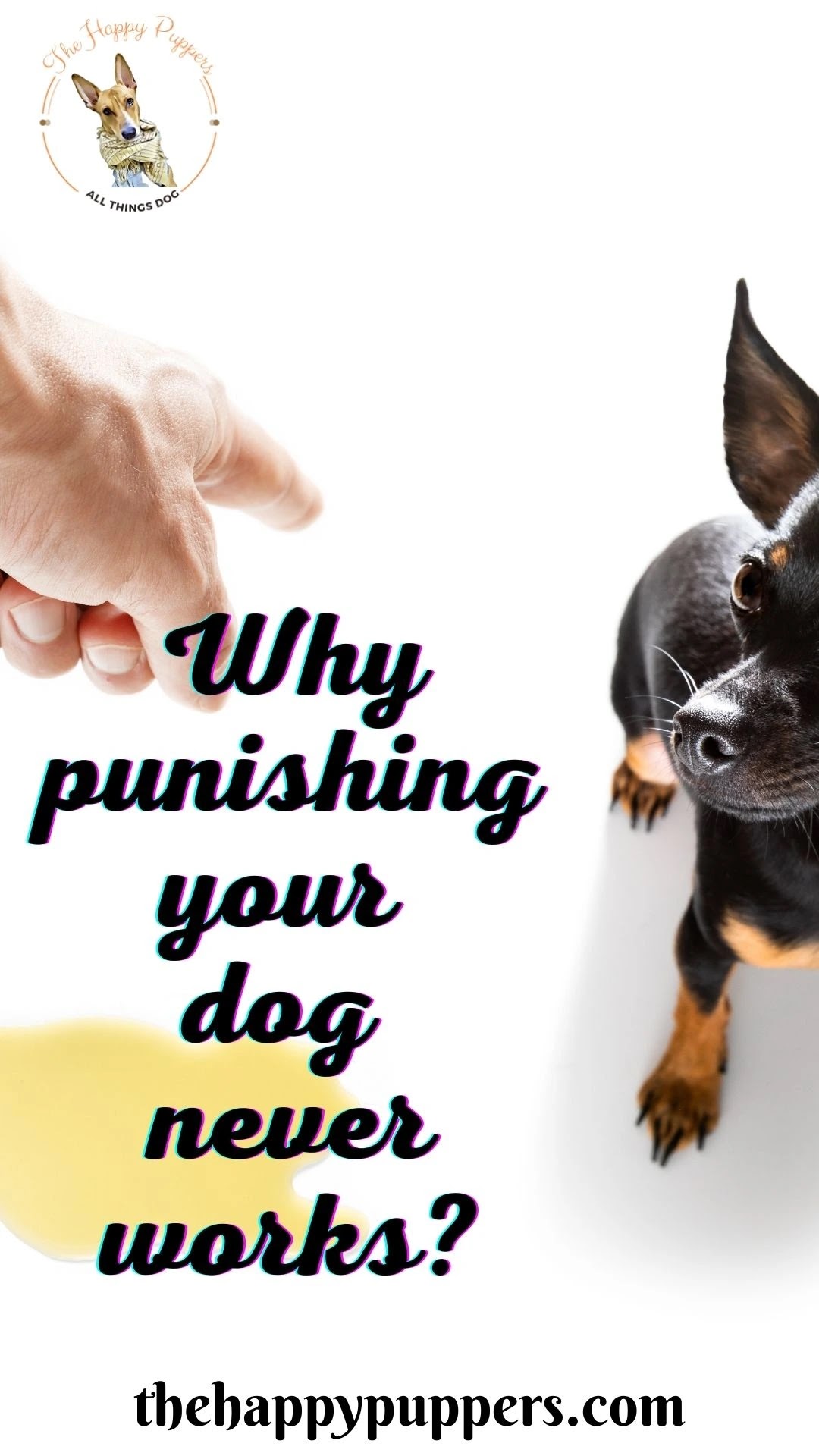
Are you punishing your dog? Stop right now. Punishing your dog never works
This is possibly the most discussed topic on dog forums and Facebook groups. Is punishing your dog effective or not, and if punishing is ineffective, what should they do instead to correct the pup’s behaviour? First, you must understand that your dog is your child. It would help if you treated your dog the same way you will treat your child.
Would you hit your child if they do something inappropriate? Especially when you know that your kid does not understand that the behaviour is unacceptable in the first place? You would sit your child down and explain to them why that behaviour was inappropriate, right? Following this, you would expect your child not to engage in that kind of behaviour again. The same factor applies to dogs. As a guardian, you must first teach your dog which behaviour is wrong, which is correct, and how to avoid engaging in the inappropriate behaviour instead of opting to punish your dog.

Topics covered in this blog post
What does ‘punishing your dog’ mean?
Punishing your dog refers to a behaviour that you would engage in when your dog does something you do not like. It can be a booming noise, tightening the choke collar, giving your dog a shock, vibration etc.
Related articles:
HOW TO USE SHOCK COLLARS?
WHY SHOCK COLLARS DON’T WORK?
TYPES OF SHOCK COLLARS
DIFFERENT TYPES OF NO SHOCK TRAINING COLLARS FOR DOGS
Pushing your dog: the types of punishments used
Before I move on to discussing how you should train your dog to not engage in the wrong behaviour, you must understand the different forms of punishment that are in place currently for correction of inadequate or inappropriate dog behaviors:
- Hitting your dog with a newspaper
- Shouting at your dog
- Using a choke collar
- Using a prong collar
- Yanking the leash
- Intimidating your dog with a finger
- Pushing your dog
- Jabbing your dog
- Pinning your dog
- Kneeing your dog
- Throwing things at your dog
There are so many punishment methods. There is a chance I may have missed out on a few. Feel free to reach out to me let me know what other punishment methods are used. Unfortunately, there is a chance that guardians may be engaging in such behaviour without even realizing that they are punishing their pup, and that is something they should not engage in. You can also mention them in the comment section.
If you have been finding the post insightful so far, please subscribe to The Happy Puppers so that I can send you regular updates about the new and upcoming posts in your inbox. Thus, you won’t miss out on any recent posts and stay updated with all the latest tips and tricks in dog behaviour and training.
Why do people punish their dogs?
The most common reason why people punish their dogs is to stop the wrong behaviour. The most common inappropriate behaviour in such cases are:
- Pooping on peeing in the house
- The dog licking their pee
- The dog eating their poop
- Excessive chewing behaviour
- Excessive biting behaviour
- Knocking things over while running or doing zoomies
- The dog behaving distractedly when in training
- Taking a long time to learn a new command
- Howling
People punish their dogs when they lose patience. Patience is lost when the training person is not in the right state of mind.
Related posts:
THE DIFFERENT TYPES OF DOG COLLARS AND THEIR USES
DOG CHEWING PROBLEMS? HERE ARE A FEW SOLUTIONS THAT ARE GUARANTEED TO HELP
WHAT DOES DOG HOWLING MEAN? WHY DO DOGS HOWL? 8 REASONS
WHAT ARE DOG ZOOMIES? ALL YOU NEED TO KNOW ABOUT THE ZOOMIES BEHAVIOR
For example:
Suppose a person X has to attend a meeting in 10 minutes. He decides to use those 10 minutes to train his dog for a new command. However, the dog wants to play. The dog is not responding to the guardian’s instructions and is behaving distractedly. The guardian gets frustrated and shouts at the dog to pay attention.
Why did this happen?
This happened because the guy lost his patience. He has to attend a meeting in the next 5 minutes and wants to finish the training task before the meeting commences. However, since his dog is distracted, the guardian feels that he has wasted 5 minutes without receiving any return. Thus, he shouts at the dog.
What does the dog understand?
The dog understands that his guardian is angry at him. The dog wants affection, love, and some guardian time. That is in the dog’s right. However, the guardian wants his dog to do something that the dog is not understanding. Such behaviour from the guardian regularly will make the dog fearful of the guardian. This may lead to an increase in aggressive behaviour in the dog. If such behaviour like shouting, yelling, hitting the dog with the newspaper continues from the guardian side, eventually the dog will start to associate the guardian with negative reinforcement. Eventually, when the dog sees the guardian, his first response would be to hide or react aggressively.
Conclusion, is this behaviour from the guardian okay?
No! Such behaviour for training your dog cannot be used to maintain a relationship of trust and love. Such acts from the guardian will only destroy the relationship between them and the dog.
What to do in such cases?
- If you are feeling distracted, do not train your dog.
- Do not start the training process if you think you are in a time crunch.
- If you are upset about something, do not train your dog during that time
- If you feel angry, emotional, sad etc., do not train your dog.
Pin this article for later
When should the guardian train their dog?
Train when you can stay calm and attentive. Use brief, enjoyable sessions suited to the dog rather than requiring a full uninterrupted hour. Pause if either of you is frustrated or tired.
Related articles:
CARING FOR A NEW PUPPY? 10 TIPS TO BECOMING AN AMAZING DOG GUARDIAN
YOUR TRAINING METHODS CAN MAKE OR BREAK YOUR DOG
Why should you never punish your dog?
Avoid physical intimidation, pain and fear in training. Punishment and negative reinforcement are different learning terms: punishment reduces a behavior, while negative reinforcement increases behavior by removing something unpleasant. Even when aversives suppress behavior, they can harm welfare and worsen fear. Choose reward-based methods and qualified help.
What happens when you punish your dog?
One of the critical risks of punishing your dog is that your dog may understand or see you as the source of stress and pain. Suppose you always correct your dog via physical correction without offering them a proper redirection. In that case, your dog will associate human hands with punishment.
- A fearful dog is likely to run. If the dog feels that running away is not a viable option, they will lash out aggressively.
- If your dog is confident or stubborn, they are more likely to fight you.
- Your dog may turn extremely fearful, refuse to eat and crouch in the corner of the house.
- Suppose you are punishing your dog for eating poop or drinking their urine. In that case, your dog may start indulging in such behaviour more frequently. Your dog will realize that him pooping or peeing in the house, or eating it is not the problem. The problem is you finding the evidence. They will try to clear it up faster so that you do not see it and they do not get scolded.
Correction or punishment?
Teach and reward the behavior you want, manage access to hazards and prevent rehearsal of unwanted behavior. Avoid euphemisms such as correction for physical or psychological punishment; reward-based training is the recommended approach.
Sometimes, punishment may even have an opposite effect on your dog. Your dog may feel that you are not punishing him. Instead, you want to play with him. Suppose your dog chewed your shoes. You yell at your dog, and you try to take the shoes away. When you yell at your dog, instead of telling your dog that this behaviour is wrong, your yelling means your dog that this is playtime. Your yelling gets your dog excited, who in turn grabs the shoe even tighter in their mouth and turns it into a tug of war match rather than just dropping the shoe and letting you have it.
Correction methods:
Timing
Dogs learn through associations and consequences, but there is no universal 45-second attention span or 30-second correction window. Mark and reward a desired response promptly. Punishing a dog after the event does not teach the alternative you want.
Supervise and manage the environment. Calmly redirect to an appropriate activity when it is safe and reward that choice; do not shout, startle or rely on a stern NO.
For example, suppose your dog chewed up your umbrella. By the time you notice that the umbrella has been chewed, it has already been half an hour. Now, if you tell your dog no, it will not have any effect. Therefore, you must keep a strict eye on your dog so that you can correct the behaviour immediately. Suppose you decide to correct your dog half hour late when your dog is engaging in playtime; this will only teach your dog to not engage in playtime. This will not teach your dog that chewing the umbrella is wrong.
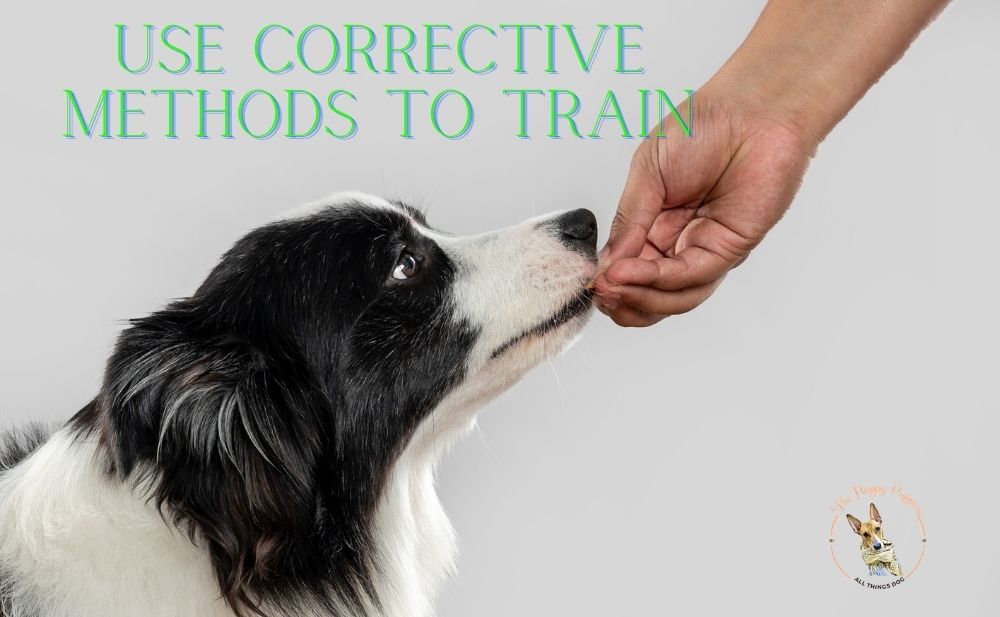 |
| Use corrective methods to train your dog |
Work on trading
Teach drop and trade using low-value safe items and a better reward. Do not chase, pry the mouth open or reach for an item if the dog stiffens, growls or guards. Move away, separate children and seek qualified behavior help. Suspected swallowed toxins or dangerous objects need an immediate veterinary call.
Eventually, your dog may start bringing you your shoes and giving them to you in exchange for a treat. This is a comparatively acceptable behaviour compared to your dog chewing up the shoes or umbrella. You can use this tricks while you are training your dog to understand the ‘drop it’ command. When your dog learns the ‘drop it’ command, use the ‘drop it’ command to signify that the dog must drop the item. When your dog lets go of your shoe following the ‘drop it’ command, reward them with a treat.
Always reward
If you want your dog to understand new commands and follow them every time, you also have to make efforts from your side. Whenever your dog follows your command, praise, shower with affection, offer some treats, etc. Do something positive for your dog in return. This will cement it in your dog’s mind that when they do something favourable, they get positive reinforcement. This will encourage good behaviour in your dog.
Personal experience
I live in a place where more dogs live on the streets than humans living in houses. Many of these dogs have been deemed feral by the people living around me. However, what I see is that these dogs are misunderstood. It recently came to my knowledge that one dog was deemed feral to the point that people were leaving their houses with sticks in their hands, afraid of the dog. On asking, they told me that the dog would charge and try to bite them. They failed to see that the dog had his tail tucked under him at all times. This was not an aggressive dog. This was a scared dog. All I had to do was do the dog, crouch near and offer him a treat. He ate the treat from my hand and decided to trust me. Now, he’s a part of my pack, which involves a lot of other dogs who have been deemed feral but are misunderstood.
The lesson learned is that the dog was not inherently feral. He was beaten up by humans, due to which he started viewing humans as an entity that would always hit him. Most dogs under such conditions become scared and try to avoid human contact. However, sometimes they misunderstand the situation and think that someone might hurt them when the reality may not be so. This leads to the dog harming someone who might be innocent.
It is not only the responsibility of the dog guardian to behave in the proper manner with their dogs. It is every human being’s responsibility to display a little more compassion and a little less frustration towards these voiceless souls. You must understand that dogs are misjudged and most often misunderstood. I could win over an alleged feral dog by offering him just a little bit of love and affection. Now when I get out of my house, I have him greeting me almost every time. He will come to me, ask for affection, belly rubs, pets, etc. This is the dog the world should have seen. Unfortunately, it was the fault of humans that the dog was seen as feral. All of this I achieved within three days.
Conclusion
Punishment after the event does not teach the desired behavior. Learning has no universal one-year deadline. Build trust, use short reward-based sessions and adjust to health, age and history; seek professional help for fear or aggression.
Being a dog guardian is always associated with a learning curve. Whether this is your first dog or 5th, you will always learn something new with every dog that enters your life. You have your friends, family, relatives, etc., to look forward to. Your dog only has you. Therefore, do not punish your dog if he/she does not pick up your instructions at once.
Suppose the situation arises where your dog seems distracted all the time and is unable to pay attention. In that case, it may be due to an underlying medical condition. Your dog may be feeling under the weather and experiencing constant discomfort due to a medical issue. Therefore, in case of continuous distraction or if your dog suddenly develops aggression, go to the vet and get your dog checked. Once any medical issue have been ruled out, the training process can start.
 |
| Train your dog the right way |
If you have queries pertaining to this blog post or any other blog posts on The Happy Puppers, feel free to reach out to me on my social media channels. Alternatively, you can also leave your comments in the comment section. I will be happy to help. If you found this post informative, please subscribe to The Happy Puppers so that I can send you notifications regarding the new posts the moment they are released.
See you in my next blog post
Shruti
