

Short answer: Yes, in small amounts. Dogs can have a little plain cheese as an occasional treat (AKC; PetMD; Blue Cross). But cheese is high in fat, many dogs don’t handle lactose well, and some cheeses are a hard no: blue cheese, moldy cheese and cheese flavored with onion, garlic or chives. Dogs with pancreatitis shouldn’t have cheese at all (PetMD).
Cheese is a common training reward, but it isn’t right for every dog or every situation. Here’s what the risks are, which cheeses are better or worse choices, how much is reasonable, and what to do if your dog helps themselves to the cheese board.
Topics covered in this blog post
Can dogs eat cheese?
AKC says yes: dogs can eat cheese, and it’s often used as a training reward. Some dogs are intolerant, though, so moderation is best. PetMD agrees that dogs can eat cheese in moderation, and UK charity Blue Cross says most cheeses are not toxic but should only be given in very small amounts as a treat.
The main concerns are:
- Lactose: many dogs struggle to digest it (PetMD; ASPCA).
- Fat and calories: too much cheese can cause weight gain and could lead to pancreatitis (AKC).
- Added ingredients: some cheeses contain garlic, onions or chives, which are toxic to dogs (AKC).
- Blue and moldy cheese: these need special care (PetMD; Blue Cross; Merck Veterinary Manual).
Are dogs lactose intolerant?
PetMD says most dogs are lactose-intolerant, so too much cheese may cause diarrhea or other digestive upset. The ASPCA explains that pets don’t have much lactase (the enzyme that breaks down lactose), so milk and other dairy products can cause diarrhea or other digestive upset. Blue Cross adds that lactase levels drop as dogs age, which can cause vomiting, diarrhea, bloating or stomach pain.
AKC notes that cheese has little lactose compared with whole milk, but dogs with severe lactose intolerance may react even to small amounts. Watch for intestinal upset the first time you offer it.
Cheese, fat and pancreatitis
Cheese is high in fat. AKC warns that feeding too much regularly can cause weight gain and obesity and could lead to pancreatitis, “a serious and potentially fatal illness in dogs.” PetMD says dogs with pancreatitis should not eat cheese.
According to AKC, a high-fat diet is one of the most common triggers of pancreatitis, and even a single large serving of fatty food can set off an episode in some dogs. AKC also notes that emergency clinics often see more pancreatitis cases after holidays like Thanksgiving, when dogs may get into rich foods and table scraps. Signs include vomiting, abdominal pain, loss of appetite, lethargy, diarrhea, dehydration, fever and a hunched back. Pancreatitis can become life-threatening, so a dog showing several of these signs at once should see a vet as soon as possible. Dogs that have had pancreatitis need careful diet management, and a high-fat treat could trigger another episode (AKC).
Which cheeses are better or riskier for dogs?
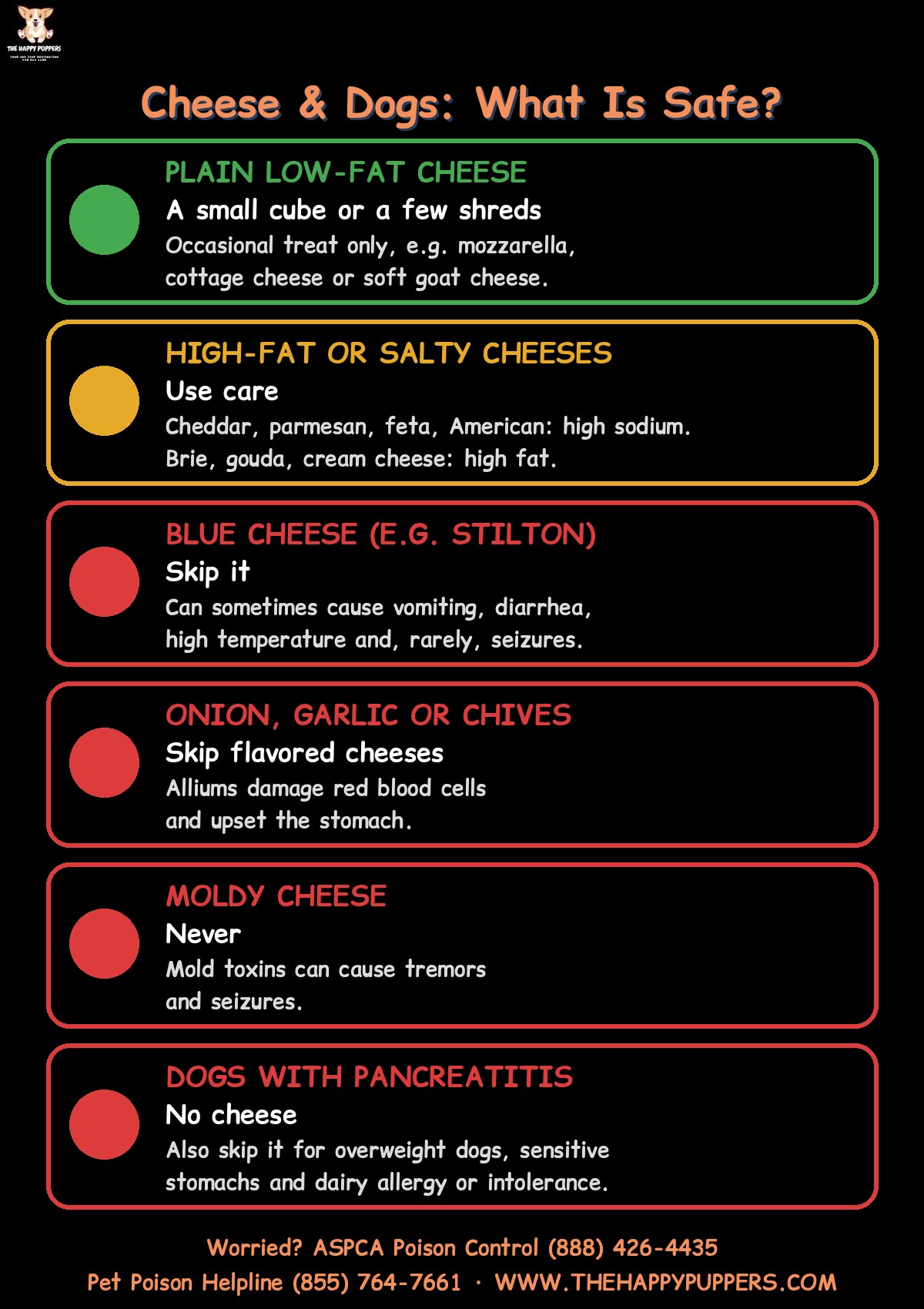
AKC says low-fat cheeses such as mozzarella, cottage cheese or soft goat cheese are the best choices. PetMD compares common cheeses this way:
- Mozzarella and goat cheese: lower in lactose and saturated fat (PetMD).
- Cottage cheese: high in protein. AKC says it is lower in fat, sodium and lactose than other cheeses, while PetMD still lists it as high in lactose. If your dog is sensitive to dairy, start with a very small amount and ask your vet.
- Cheddar, parmesan and provolone: high in sodium and saturated fat (PetMD).
- Feta: high in sodium and lactose (PetMD).
- Cream cheese, brie and gouda: high in saturated fat (PetMD).
- American cheese: processed and high in sodium (PetMD).
- Blue cheese: avoid it (PetMD; Blue Cross). See below.
A note on salt
Some cheeses are high in sodium (PetMD), which is one more reason to keep portions tiny. Separately, Pet Poison Helpline explains that a salt overdose in general can cause vomiting and diarrhea, neurological signs such as stumbling, disorientation, tremors and seizures, and even death.
Cheese with onion, garlic or chives
AKC warns that some cheeses contain herbs or other products that are toxic to dogs, such as garlic, onions and chives, and Blue Cross says added onion, garlic or herbs could be harmful.
Garlic, chives, onion and leeks belong to the Allium family. Pet Poison Helpline says they are poisonous to dogs: toxic doses damage red blood cells, leading to anemia, and cause stomach upset. Japanese breeds such as the Akita and Shiba Inu are more sensitive. The ASPCA likewise lists onion, garlic and chives as causing stomach irritation and red blood cell damage. Read the label and skip cheeses flavored with these ingredients.
Can dogs eat blue cheese?
No. PetMD says to avoid blue cheese because it “contains roquefortine” and lists it as toxic. Blue Cross says blue cheese such as Stilton should be avoided because the fungus used to make it can sometimes cause vomiting, diarrhea, high temperature and, rarely, seizures. If your dog shows these signs after eating blue cheese, call your vet urgently (Blue Cross).
Can dogs eat moldy cheese?
No. Keep moldy cheese, like any moldy food, away from your dog. The Merck Veterinary Manual explains that mold, especially Penicillium, growing on food including dairy products can produce tremor-causing toxins (mycotoxins). Signs include vomiting, tremors, wobbliness, a fast heart rate and seizures, starting within 1 to 2 hours or up to several hours after eating. Large exposures can cause seizures and death. Merck advises keeping dogs away from moldy food and food waste, including compost.
Can dogs eat mac and cheese?
It’s not recommended. PetMD says the dairy and gluten in mac and cheese can be hard for dogs to digest.
How much cheese can a dog have?
- Keep it small: AKC says cheese should be an occasional treat, and “a small cube or a few shreds is usually enough.”
- Follow the 10% rule: PetMD says treats, cheese included, should follow the 10% rule. Its portion chart goes by dog size (for example, 1 to 2 pea-size pieces for extra-small dogs), and it suggests cheese “a few times per week at most.”
- Start slow: offer a tiny piece first and watch for vomiting, diarrhea, bloating and gas (PetMD).
- Ask your vet: PetMD suggests discussing the amount and frequency with your vet, and AKC says to check with your vet first if your dog is obese or has food sensitivities.
Blue Cross says overweight dogs, dogs with a dairy allergy or intolerance, and dogs with sensitive stomachs should not have cheese, and PetMD says dogs with pancreatitis should not eat it.
My dog ate a lot of cheese. What should I do?
- Work out what they ate: what kind of cheese, how much, and whether it was blue, moldy or flavored with onion, garlic or chives. The ASPCA suggests noting the amount.
- A large amount of plain cheese: Blue Cross says a dog that eats a lot (such as a whole block) may vomit, so watch them and call your vet if they become unwell. Because a single large serving of fatty food can set off pancreatitis in some dogs, watch for its signs too (AKC).
- Blue cheese: call your vet urgently if your dog has vomiting, diarrhea, a high temperature or seizures (Blue Cross).
- Flavored cheese with onion, garlic or chives: call your vet or a poison control line. Alliums can damage red blood cells (Pet Poison Helpline; ASPCA).
- Moldy cheese: call your vet right away. Signs such as vomiting and tremors can start within 1 to 2 hours (Merck Veterinary Manual).
- Don’t try to make your dog vomit unless your vet tells you to. Pet Poison Helpline warns that salt should never be used to induce vomiting.
If your dog ate something risky
Call your vet, or the ASPCA Animal Poison Control Center at (888) 426-4435 or Pet Poison Helpline at (855) 764-7661 (fees may apply). Tell them what your dog ate, how much, and your dog’s weight.
Related reading: Garlic for dogs · Can dogs eat ham? · Can dogs eat turkey?
Frequently asked questions
Yes, in small amounts as an occasional treat (AKC; PetMD; Blue Cross). Cheese is high in fat, many dogs are lactose-intolerant, and blue, moldy and onion- or garlic-flavored cheeses should be avoided.
Most cheeses are not toxic (Blue Cross), but too much can cause digestive upset and weight gain, and too much fat could lead to pancreatitis (AKC; PetMD).
AKC suggests low-fat cheeses such as mozzarella, cottage cheese or soft goat cheese. PetMD lists mozzarella and goat cheese as lower in lactose and saturated fat.
AKC lists it among the better choices and says it is lower in fat, sodium and lactose than other cheeses. PetMD says it is high in protein but still high in lactose, so start with a very small amount.
No. PetMD says to avoid it, and Blue Cross says blue cheese such as Stilton can sometimes cause vomiting, diarrhea, high temperature and, rarely, seizures. Call your vet urgently if these signs appear.
AKC says a small cube or a few shreds is usually enough. PetMD recommends the 10% rule for treats, a few times per week at most, and talking to your vet about the right amount.
No. PetMD says dogs with pancreatitis should not eat cheese, and AKC says a high-fat treat could trigger another episode.
Sources
- AKC: Can Dogs Eat Cheese?
- PetMD: Can Dogs Eat Cheese?
- Blue Cross: Can dogs eat cheese?
- AKC: Pancreatitis in Dogs: Signs, Symptoms, Treatment
- Merck Veterinary Manual: Tremorgenic Neuromycotoxicosis in Dogs
- Pet Poison Helpline: Garlic
- Pet Poison Helpline: Salt
- ASPCA Animal Poison Control: People Foods to Avoid Feeding Your Pets
