

Getting a new puppy is a fun and fulfilling experience. These adorable critters rapidly earn their place as cherished members of the household, bringing unconditional love, devotion, and friendship. The responsibility of bringing up a healthy and happy dog comes hand in hand with all the fun of having a new puppy. An organized puppy schedule is an essential tool for new guardians and marks the beginning of this journey.
The key to giving your puppy the best possible care, training, and socialization is a well-thought-out regimen. It helps you deal with the ups and downs of puppyhood and lays the foundation for a well-behaved and happy adult dog. Following the guidelines laid out in this blog post, you can expect your new puppy to mature into a well-adjusted and well-behaved member of your family and community.
This article is meant to provide you the tools you need to establish a routine with your puppy, whether you’re a first-time pet parent or just want to brush up on your abilities. So let’s get started on this adventure together and make the first few months with your new puppy as fun and fulfilling as possible for both of you.
Topics covered in this blog post
Sample puppy schedule (8–16 weeks)
A simple day for a young puppy, if you’re home. Shift the times to fit your day; what matters is the order and the frequent potty trips.
- 6:30 AM Wake up, straight outside to potty
- 7:00 AM Breakfast, then potty again; short play and a 2–3 minute training game
- 8:00 AM Nap in the crate or pen (potty as soon as the puppy wakes)
- 10:00 AM Potty, play, gentle socialization (a new sound, surface or person)
- 11:00 AM Lunch (for 4-meal puppies), potty, nap
- 1:00–4:00 PM Potty every 1–2 hours when awake; chew toy or food puzzle; nap
- 4:00 PM Third meal, potty, play
- 6:00 PM Short training session, calm handling (paws, ears, mouth), potty
- 7:30 PM Last meal, then potty
- 9:30–10:00 PM Quiet time, last potty, bed
- Night One quiet potty trip if needed (most puppies until about 4–5 months)
Young puppies sleep about 18–20 hours a day, so a lot of the schedule is naps. If you work outside the home, a puppy shouldn’t be left alone for more than about 3 hours. Arrange a midday visit or use a pen with a potty pad (VCA).
How the schedule changes with age
- 8–12 weeks: 4 meals; potty every 1–2 hours awake, after every nap, meal and play; night trip.
- 3–6 months (incl. 4 and 5 months): 3 meals; potty about every 2–3 hours; most puppies sleep through the night by 4–5 months; finish the vaccine series and keep socializing.
- 6–12 months: 2 meals; potty every 4–6 hours; longer walks and training; ask your vet when to switch to adult food.
If you wish to be the best dog guardian for your dog and stay on top of all the tips and tricks regarding the dog care world, please subscribe to The Happy Puppers blog. The subscription option is present in the sidebar. If you like watching videos. Subscribe to the YouTube channel of The Happy Puppers, Shruti and Delta. Remember to ring the notification bell so that YouTube reminds you every time a new blog video releases.
Puppy schedule: the daily routine
Your puppy’s healthy growth and development depend on a consistent daily regimen. Your puppy will benefit from the stability and regularity it gives, which will make him or her feel more secure and allow him or her to flourish. Here’s a rundown of your puppy’s normal day:
Starting the day:
- Wake up your puppy slowly and gently to start the day.
- Offer a healthy puppy food and clean water to your new pet.
- Take your puppy outside to a designated potty place just after feeding time.
- Have some low-key playtime with your puppy to get him or her up and moving and to burn off some excess energy.
Socialization and Playtime
- Spend time playing with your puppy, including with interactive activities and toys, to help them develop healthy relationships with people and other animals.
- Introduce short training sessions for basic commands like sit, stay, and come. The benefits of mental exercise are comparable to those of physical activity.
- During socialization outings, take your puppy to meet new people and see new places.
- Start safe socialization right away. Until the vaccine series is finished, carry your puppy in public, avoid dog parks and pet stores, and only let them meet healthy, vaccinated dogs (AVSAB).
Puppy schedule: naps
- Puppies require long periods of sleep; therefore, a calm and cozy space should be made available for them to rest.
- Puppies may need to nap several times a day, so pay attention to their indications and give them naps whenever they ask for them.
- Provide a safe and comforting environment in a crate when your dog needs to rest or be quiet.
Evening and Bedtime Routine
- Feed your puppy a small amount of food and water in the early evening, then take it outside to use the restroom.
- Establish a relaxing routine that includes a reassuring walk or playtime before bedtime and low lighting.
- Get your puppy used to spending the night in their crate or bed.
Keep in mind that your puppy’s requirements will change with his or her age, breed, and personality. You’ll need to make adjustments to the regimen based on your puppy’s specific needs. Also, remember that pups do best with a consistent routine and frequent praise. Your puppy will grow up to be a well-adjusted dog with the help of the structure and routine you provide in your daily interactions.
Puppy schedule: feeding times
Maintaining a regular feeding routine is essential for your puppy’s health and development. Puppies have unique dietary needs and should be fed a balanced diet on a consistent basis. Here’s a basic outline of a puppy feeding schedule:
- Choosing the Appropriate Puppy Food
- Discuss the breed, age, and size of your dog with your vet to decide the best puppy food.
- Go with a commercial puppy food of good quality, one that abides by the guidelines established by groups like the Association of American Feed Control Officials (AAFCO).
Puppy schedule for feeding: Serving Sizes
- Figure out how much food your puppy needs based on its age, size, and degree of activity. As a starting point, read the instructions on the food’s packaging.
- Keep an eye on your dog’s growth and make any required adjustments to his or her diet. Avoiding obesity requires avoiding overfeeding.
Puppy schedule: meal times
- Puppy growth is quick, thus they need to eat more often than adult dogs.
- Puppies between the ages of 8 and 12 weeks often require four meals per day.
- By the time your puppy is three to six months old, you can cut back to three meals a day.
- By roughly 6-12 months of age, most puppies can adapt to two meals a day.
Scheduled Meal Times
- Create a routine for your puppy by giving it regular feedings at the same times each day.
- Mealtimes ought to match with things like bathroom breaks and playtime.
- Disruptive eating patterns can develop if food is left out all day, so do not free feed your puppy. Stick to the designated puppy schedule.
Mealtime Manners
- To prevent your puppy from developing food guarding behavior, train them to wait for your signal before reaching their food bowl.
- Create positive associations with food by providing lots of praise and encouragement during meals.
- Don’t take the bowl away while your puppy is eating. Instead, walk by and drop in a tasty extra so your puppy learns that people near the bowl are good news.
Feeding your puppy on a regular schedule and with high-quality puppy food will ensure that he gets all the nourishment he needs at this critical stage in his development. Maintaining a regular mealtime schedule that includes consistent feeding times and appropriate portion sizes can aid in the prevention of stomach problems. In addition, your puppy’s nutrition can be fine-tuned at each visit to the vet based on its individual needs.
Socialization
Raising a well-mannered and self-assured dog requires a commitment to socialization and training. Socialization is a crucial part of your regular puppy schedule. The most important window closes at about 14–16 weeks, before the vaccines are finished, so start safe socialization as soon as your puppy comes home (AVSAB). Your puppy can develop into a well-adjusted adult canine companion with your early and regular efforts in these areas. Here’s a basic framework for introducing and training your puppy:
The Importance of Socialization
- Realize the significance of socializing during the first several months of a puppy’s life, when he or she is still developing rapidly (3-14 weeks).
- Expose your puppy to a wide diversity of people, animals, surroundings, and experiences.
- Adult dogs are less likely to exhibit anxiety, hostility, and aggressive conduct if they were socialized as a part of their puppy schedule.
Fundamental Commands
- Your puppy schedule must include a section for training. Training your puppy starts the day the puppy enters your home.
- Begin by teaching your puppy the standard commands to be used in the rest of his or her life.
- Some crucial commands to start with are: Sit, then Stay, then Come, and finally, Down.
- To encourage your dog, use praise and treats.
- Train your puppy in short, enjoyable sessions to keep his attention (10-15 mins).
Housebreaking and toilet training
- The next part of your puppy schedule is the housebreaking and toilet training procedure. Establish a reliable schedule for toilet training and make sure you stick to it.
- Take your puppy to the same spot first thing in the morning, after every meal or big drink, right after naps, every 30 minutes during active play, every 1–2 hours while awake, and last thing at night (VCA).
- Praise and give a treat right away, outside, when your puppy pees or poops in the right spot.
- Be patient and avoid punishment for accidents, as it can impair the training process.
Physical exercise:
- The next part of your puppy schedule is engaging your pup in plenty of physical and mental exercise.
- Physical activity is essential for the mental and emotional wellbeing of puppies.
- Involve your puppy in playtime and brief walks, tailoring the frequency and length of each activity to his or her age and breed.
- To keep your puppy’s intellect sharp, give it puzzle toys, training games, and new challenges.
Puppy schools
- This is more like an optional step. If you are not well versed in the process of dog training or if you are struggling with training your new pup, you can opt for puppy schools.
- Training schools not only train the puppy, they train the guardian as well.
- Your relationship and bond with your puppy will improve when you engage in tasks together.
- You can find the correct class for your puppy’s age and needs by consulting with your vet or local trainers.
- If you decide to opt for puppy school, add it into the puppy schedule that you designed for you and your pup.

Puppy schedule: Health and Veterinary Care
Your puppy’s long and healthy existence depends on your diligent care and regular visits to the vet. Important factors in your puppy’s health and veterinarian care are as follows.
Puppy Schedule for Vaccinations
- Consult with your dog’s veterinarian to create a vaccination plan that is appropriate for your puppy’s age and breed.
- Puppy immunizations against distemper, parvovirus, and rabies are the most common vaccinations.
- Depending on where you live, your puppy may need some additional vaccines.
- Ensure your puppy receives booster injections as needed to maintain immunity.
- Puppy classes can start at 7–8 weeks of age, at least 7 days after the first vaccines (AVSAB).
Regular Vet Checkups
- Beginning at around 6-8 weeks of age, you should begin taking your puppy for frequent checkups at the vet.
- Dietary and temperament counseling as well as physical examinations are part of these checkups.
- Regular check-ups help early detection of health concerns.
- Make sure to include dental checkups also in this process.
- Mark the dates and times on your monthly puppy schedule so you do not miss out.
Worm management
- Block the dates and time on your puppy schedule for this task.
- Parasite management procedures, like deworming, flea and tick prevention, will be recommended by your veterinarian.
- Use the items and provide them at the intervals recommended by your veterinarian.
- Be on the lookout for fleas and ticks on your puppy on a consistent basis.
Personal Hygiene and Dental Treatment
- Make personal hygiene a priority by consistently brushing, washing, and cutting your puppy’s nails.
- Brushing should be a part of the daily puppy schedule.
- Nail trimming should be scheduled weekly or depending on the speed at which your puppy’s nails grow.
- Your puppy’s oral health depends on consistent dental care. Consult your veterinarian about the use of dental chews and toothbrushes.
- Your puppy will be more at ease with grooming and dental care if you start early.
- Touch different parts of your puppy’s body as a part of his daily puppy schedule so that your pup gets desensitized to human touch.
Puppy Schedule: Playtime
Puppies need lots of exercise and playtime to thrive and develop normally. The health, happiness, and cerebral stimulation of your dog can be maintained by regular, structured playtime and exercise. Here’s a basic framework for puppy playtime and exercise:
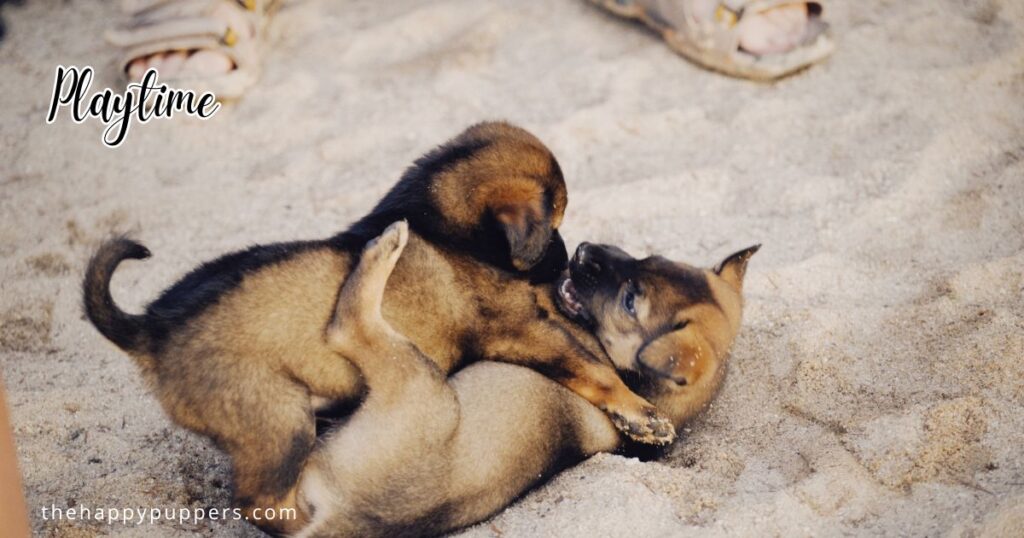
Playtime schedule
- The exercise requirements of various puppy breeds and sizes vary.
- Have the puppy playtime as a part of your puppy schedule.
- The timings and duration of the playtime will be primarily dependent on your dog’s breed and temperament.
- Discuss your puppy’s age and breed with your vet to come up with an appropriate activity schedule.
- Have your puppy participate in interactive play sessions with toys that promote chase, fetch, and pull.
- Swap out the toys every so often to keep things fresh and avoid boredom.
- Treat dispensing toys and puzzles are fun and good for the mind.
- Low tunnels and cones are fun for puppies; save jumps until your vet says your puppy has finished growing.
Puppy schedule: Mental Exercise
- A bored puppy is more likely to chew, bark and get into trouble, so mental exercise matters every day.
- Mental exercise keeps your dog’s brain busy at every age.
- Make sure mental exercise is a part of your puppy schedule.
- Offer your puppy mental stimulation through puzzle toys, treat puzzles, and interactive activities.
- Use playtime as an opportunity to teach commands and reward good puppy behavior.
Schedule in rest periods
- Puppies require both active play and long periods of rest.
- Exercising too much might put stress on developing muscles and joints.
- Schedule calm, peaceful times throughout the day in your puppy schedule so your puppy can rejuvenate.
Outdoor Activities.
- Limit your puppy’s exposure to the outdoors to brief, supervised excursions.
- Keep your pet under control with a sturdy leash and collar or harness.
- Avoid unknown dogs and places many dogs visit until the vaccine series is done; meet known, vaccinated dogs instead.
How to Make Schedule Adjustments for Your Puppy
Your puppy’s schedule and requirements will shift as it develops into an adult. You’ll need to make adjustments to the routine as your puppy grows. Here’s a rough guideline for adjusting the routine as your puppy develops:
Modifying Daily Puppy schedule
- Realize that there are different phases of a puppy’s life, such as childhood, puberty, and adulthood.
- Anticipate having to modify your daily routine as your puppy grows in size and energy level.
- Flexibility and awareness of your puppy’s requirements are crucial.
Changing food
- Discuss the transition from puppy food to adult dog food with your vet.
- If you want to save your puppy any stomach trouble, you should make the switch to the new diet over the course of a week to ten days.
- Keep an eye on your puppy’s eating habits and general well-being after the change.
Varying Feeding Intervals
- Age-related reduction in the number of recommended daily meals:
- Most canine companions can begin eating three times a day at around the 3-6 month mark.
- Most puppies can transition to twice-daily feedings between 6 and 12 months of age.
- See how much food your puppy consumes and go from there.
Physical Activity and Exercise
- To prevent premature fatigue, puppy exercise sessions should be shorter and less intense.
- As your puppy matures and gains muscle, slowly make walks and play longer.
- Consider the breed and personality of your puppy; some are more active than others.
Cognitive Exercise
- Maintain the availability of puzzles and other forms of mental exercise.
- As your puppy learns more and more, you should increase the difficulty of games and training activities.
- Once your dog is grown, try more advanced training or beginner agility.
Training and Socialization
- Your puppy will benefit much from ongoing socializing as it grows up.
- Persist with obedience training to instill proper conduct and adherence to instructions.
- Address new challenges or behaviors that may arise during adolescence.
Related reading: puppy socialization and puppy potty training.
Conclusion
Bringing up a dog is an adventure full of happiness, difficulty, and unending love. As you set out on this journey, you’ve seen the value of a well-defined routine for your puppy. You now have a better understanding of how to provide the finest care for your young canine friend, from preparing your house for a new furry family member to adjusting the schedule as your puppy grows.
Your puppy’s health and happiness depend on you, and the habits you establish now will stay with them for the rest of their lives. You have learned fundamentals about hygiene, nutrition, training, and health care from this manual. By putting these tips into practice, you can ensure that your puppy grows up to be a content, healthy dog.
If you found these tips insightful, please subscribe to The Happy Puppers. The subscription option is present in the sidebar. If you like watching videos, subscribe to the YouTube channel of The Happy Puppers, Shruti and Delta. Do not forget to ring the notification bell so that YouTube never misses out on notifying you about the latest releases.

Always keep in mind that your puppy is an individual, and your attitude should reflect that. If you treat your puppy with kindness, constancy, and love, your relationship with it will flourish. Appreciate the small victories, remember the big ones, and don’t be afraid to get help when you need it. Raising a puppy is a wonderful experience that, if done right, will bring you joy, excitement, and a loving companion for the rest of your life.
See you in my next blog post
Frequently Asked Questions:
Puppies are normally ready to leave their mother and littermates at roughly 8 weeks of age. They will have picked up crucial social skills from their older siblings and be emotionally mature enough to form strong bonds with their new family if adopted at this time.
Puppies require many feedings per day. Puppies between the ages of 8 and 12 weeks may need four meals per day; this number often decreases to two between the ages of 6 and 12 months.
A regular schedule is essential. Take your puppy out first thing in the morning, after meals, naps and play, every 1–2 hours while awake, and before bed. Reward right away outside, never punish accidents, and clean them with an enzyme cleaner.
As young as 8 weeks of age, you can begin your instruction. Put your energy into learning basic instructions like “sit,” “stay,” and “come.” Getting started with training at a young age lays a solid groundwork for future growth.
A well-adjusted adult dog is one that has received ample socialization. You should socialize your puppy with a wide range of people, other animals, and settings. Early socializing (between 3 and 14 weeks of age) is crucial, as is gradual exposure. You don’t need to wait for all the vaccines: start safely as soon as your puppy comes home (AVSAB).
Three meals a day, potty breaks every 2–3 hours and after naps, meals and play, two or three short training sessions, plenty of naps, and daily safe socialization. Most 4-month-old puppies can sleep about 6–7 hours at night.
After every meal or big drink, right after waking up, every 30 minutes during active play, every 1–2 hours while awake, and at least every 4 hours even when resting. Young puppies also need a night trip until about 5 months (VCA).
Yes, and you should. The socialization window closes around 14–16 weeks, before the vaccines are finished. Carry your puppy in public, invite healthy vaccinated dogs over, and join a puppy class once your puppy has had a first set of vaccines at least 7 days earlier, but avoid dog parks and pet stores until the series is done (AVSAB).
Feed and potty before you leave, then arrange a midday potty break and play (a family member, friend or dog walker) so your puppy isn’t alone for more than about 3 hours. Use a puppy-proof pen with a bed, water, toys and a potty pad for the time alone.
