
Last Updated: February 11, 2026
Hey there, fellow dog lovers! If you’ve ever come home to find your shoes chewed up or your pup pacing restlessly, you know that physical exercise alone isn’t enough. That’s where mental stimulation for dogs DIY comes in – it’s all about engaging their brains with simple, home-made activities that keep them content and out of trouble. As someone who’s raised three energetic pups, I’ve seen firsthand how these tricks turn a bored dog into a joyful one. In this guide, we’ll dive into why it’s important, share tons of easy ideas, and back it up with tips to make it work for your furry friend.
Let’s start with some eye-opening numbers. In the US, 84% of pet owners report that their animals have a positive impact on their mental health, often through companionship that combats boredom. But flip that – dogs can suffer too, with boredom leading to destructive behaviors in up to 30% of cases. According to a Texas A&M study, more than 99% of US dogs have at least one behavior problem, often linked to insufficient mental stimulation. Additionally, about 80% of dog owners report increased destructive activity when their pets are bored. Enrichment activities can lead to a 63% decrease in destructive behaviors at home. Globally, including in India and other nations, over 64% of young dog owners say their pets help reduce stress, highlighting the mutual benefits. Mental stimulation for dogs DIY isn’t just fun; it’s essential for their well-being.
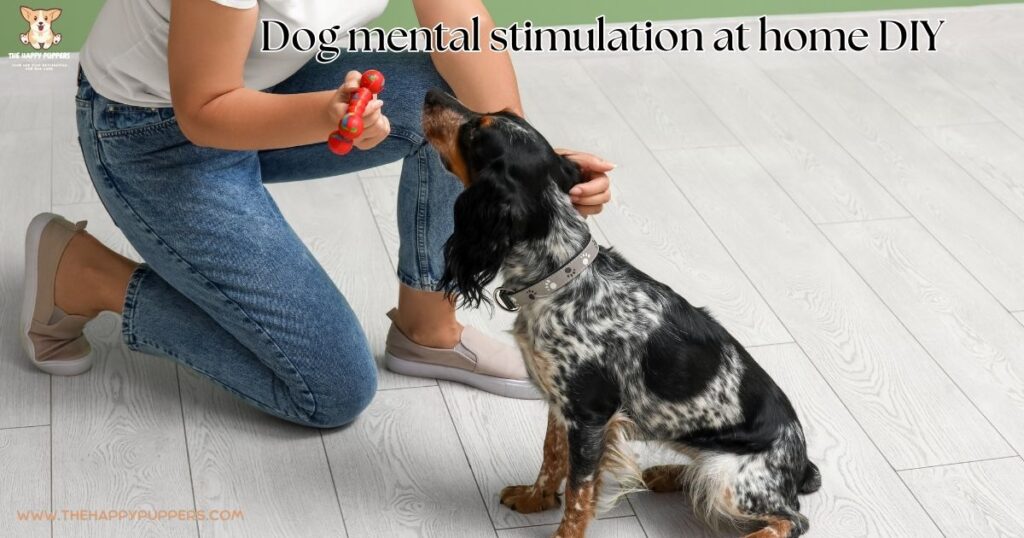
Topics covered in this blog post
Quick Answer: Mental Stimulation for Dogs DIY
Quick Tip: Mental stimulation for dogs DIY means using everyday household items to create brain-boosting games that keep your pup engaged, reduce boredom, and prevent destructive behaviors like chewing or barking. It’s as effective as a long walk but only takes 10-15 minutes!
Top 3 Easy Ideas to Start Today:
- DIY Puzzle Toy: Stuff treats in toilet paper rolls inside a box—let your dog sniff and paw them out (great for problem-solvers like Beagles).
- Find It Game: Hide treats around the room and command “find it” (perfect for scent hounds or indoor days).
- Frozen Treat: Stuff a Kong with peanut butter and kibble, freeze it—ideal for chewers and teething pups.
For best results, rotate activities weekly and supervise play. This can cut destructive behaviors by up to 63% (from enrichment studies). Dive into the full guide below for more!
Why Mental Enrichment for Dogs is Crucial?
Dogs thrive on more than just food, water, and walks—they need mental challenges to stay happy and healthy. But why is this so important? Let’s explore the reasons step by step, backed by insights from pet experts and studies. Research shows that mental enrichment not only reduces stress and anxiety by giving dogs a sense of control over their environment but also enhances cognitive function and builds confidence, leading to fewer behavioral issues overall. Experts emphasize that without it, dogs can develop stereotypic behaviors like excessive pacing or chewing, which affect up to a significant portion of pups in confined settings. Ultimately, incorporating these activities into daily routines supports overall well-being, making it essential for every dog guardian to prioritize.
The Evolutionary Roots of Dog Intelligence
Dogs are smart creatures, descended from wolves who spent their days hunting, foraging, and problem-solving in the wild. This evolutionary background means our furry friends have brains wired for constant engagement—think sniffing out prey, navigating terrain, or working in packs to survive. But in today’s modern world, many pups lead a more sedentary life: lounging at home while we’re at work, with limited opportunities to flex those natural instincts. Without enough challenges, this can lead to boredom, which often shows up as frustrating behaviors like excessive barking, digging up the yard, or even developing anxiety.
Providing mental enrichment for dogs is key because it helps mimic those ancestral activities, keeping their minds sharp, active, and fulfilled. In fact, studies show that mental stimulation can be just as tiring—and beneficial—as physical exercise, helping prevent a host of issues that affect up to 99% of dogs with behavior problems in the US (AKC, 2024).
Signs Your Dog Needs More Mental Stimulation
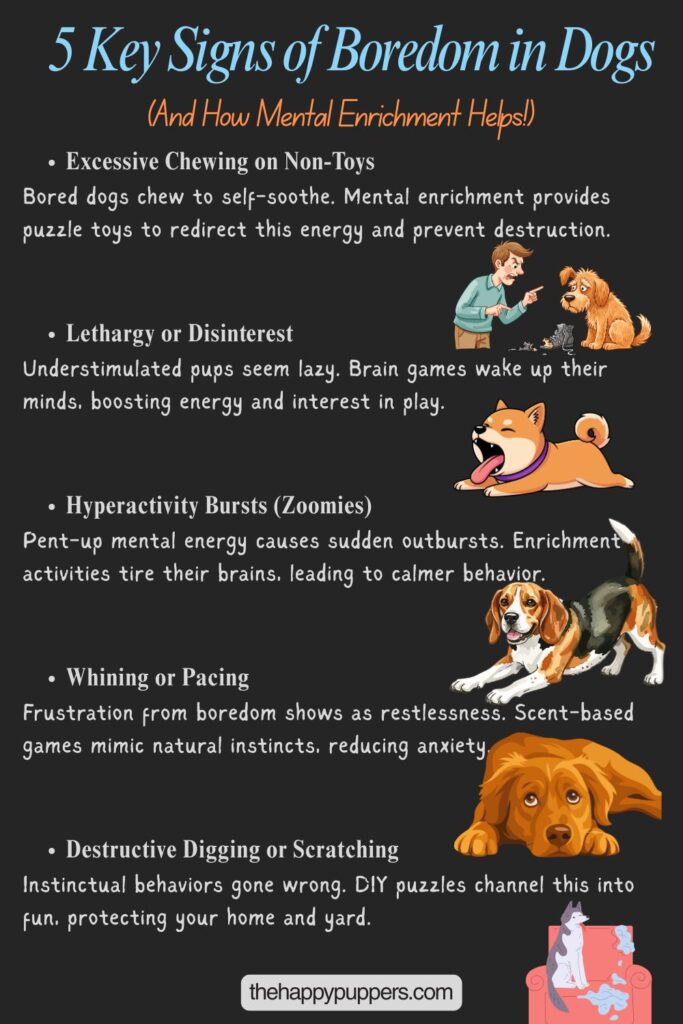
Spotting the need for mental enrichment early can save you from bigger problems down the line. Excessive chewing on non-toy items, like your favorite shoes or furniture legs, is a classic red flag—it’s often a dog’s way of self-soothing when they’re understimulated. Lethargy is another subtle clue; if your pup seems unusually lazy or disinterested in play, it could be mental fatigue from a lack of brain-boosting activities rather than physical tiredness. On the flip side, hyperactivity when you get home—those wild zoomies or jumping that won’t stop—might stem from pent-up mental energy bursting out all at once. Other common indicators include whining, pacing, or even destructive digging in the backyard. According to pet experts, without proper enrichment, dogs are far more likely to get bored and frustrated, leading to these undesirable behaviors that can strain your bond and home life (Pupford, 2025).
Here’s an infographic summarizing 5 key signs of boredom in dogs to watch out for:
Key Benefits of Mental Enrichment
The payoffs of incorporating mental enrichment for dogs into your routine are huge, making it a must for any responsible guardian. For starters, it significantly reduces stress levels—research on kenneled dogs found that simple chew toys and enrichment activities lowered cortisol (the stress hormone) and promoted calmer demeanors. In everyday homes, this translates to fewer anxiety-driven problems like separation distress, where dogs might howl or destroy things when left alone.
Better behavior is another big win
By channeling their energy into positive outlets, enrichment cuts down on destructive habits, with one study noting a 63% decrease in such behaviors when dogs get regular mental challenges. It also builds confidence, especially in shy or rescue dogs, as they succeed at puzzles or games, boosting their self-assurance over time. Stronger bonds form too—sharing these activities creates quality time, fostering trust and communication that makes training easier and your relationship deeper.
Good or senior pups
Plus, for aging dogs, mental enrichment supports cognitive health, slowing decline and keeping seniors sharp, much like brain games do for humans. And here’s a stat that might surprise you: just 15 minutes of focused brain work, like a scent game or puzzle, can exhaust a dog more effectively than an hour-long walk, thanks to the intense mental effort involved (Laylo Pets, 2025).
Supports Overall Health
Beyond immediate behavior fixes, mental enrichment for dogs plays a vital role in their long-term physical and emotional well-being. It prevents boredom-related issues that can lead to obesity (from lack of motivation to move) or even depression-like symptoms in pets. Dogs devote far more brain power to processing smells than visuals—up to 40 times more than humans—so activities like sniff walks or scent-based games tap into this superpower, making them feel more alive and content. Integrating these into your routine isn’t just nice-to-have; it’s essential for a happy, well-adjusted dog, reducing vet visits for stress-related ailments and enhancing their quality of life. As a dog guardian myself, I’ve seen how skipping this step led to chaos with my pups, but adding simple enrichments turned things around fast (Morningside Veterinary).
What do Experts Think About Dog Enrichment?
As Dr. Linda Simon, a veterinarian, puts it: “This type of mental enrichment helps prevent boredom, supports cognitive health, and strengthens the bond between dogs and their humans” (Newsweek, 2026).
Exploring DIY Enrichment Methods for Dogs
When it comes to mental stimulation for dogs DIY, there’s a world of creative options right at your fingertips using everyday household items. These methods generally fall into a few key categories that tap into your pup’s natural instincts: puzzle-based games that challenge problem-solving skills, scent-driven activities that engage their powerful sense of smell, interactive training exercises that build focus and obedience, and foraging or manipulation tasks that mimic hunting behaviors.
Each type not only keeps boredom at bay but also supports your dog’s psychological well-being by reducing anxiety, boosting confidence, and strengthening your bond—benefits backed by vet insights showing that regular enrichment can lower stress hormones and cut destructive behaviors by up to 63%. Whether you’re dealing with a high-energy puppy, a senior dog, or anything in between, these DIY approaches are adaptable, cost-effective, and perfect for indoor or rainy-day fun. Below, I’ll dive deeper into specific ideas, drawing from proven techniques to give you step-by-step guidance, variations, and real-life tips.

DIY Dog Puzzle Toys
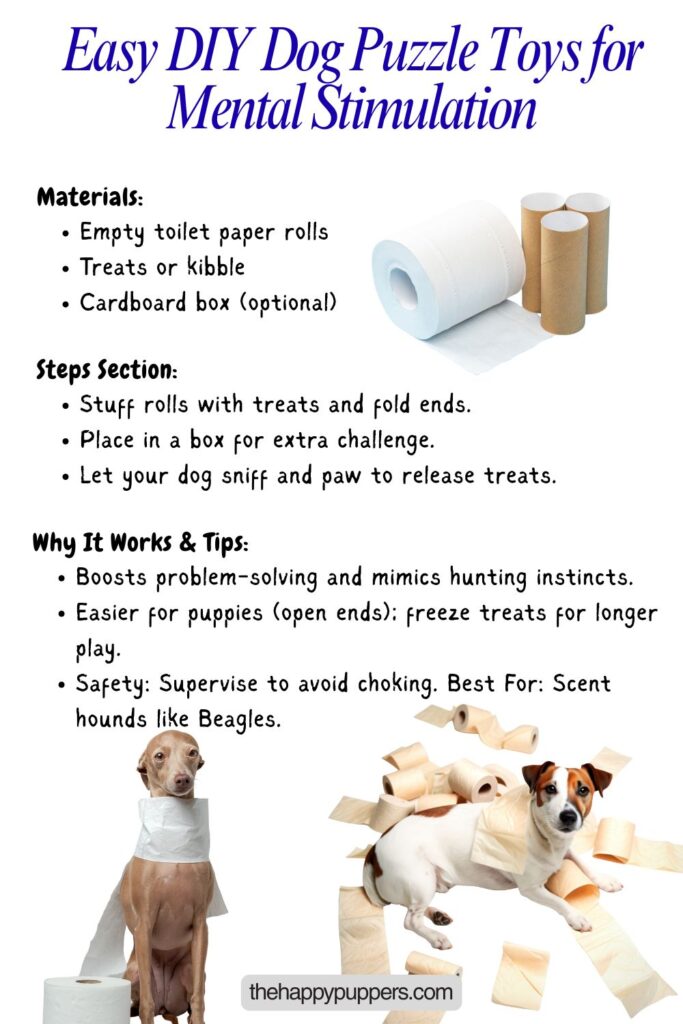
Let’s kick off with DIY dog puzzle toys, a staple for mental stimulation for dogs DIY. These hands-on challenges are fantastic for encouraging your pup to think critically and use their paws or nose to solve problems, making them ideal for rainy days or quick 10-20 minute sessions that tire them out mentally without much physical effort.
Materials: Empty toilet paper rolls, treats or kibble, a cardboard box (optional for added complexity).
Steps:
- Gather a few empty toilet paper rolls and stuff each one with small treats or pieces of kibble.
- Fold the ends of the rolls to secure the treats inside, creating a simple sealed tube.
- Place the stuffed rolls directly on the floor or inside a larger cardboard box for an extra layer of challenge.
- Encourage your dog to sniff, paw, or roll the tubes to release the treats—start by showing them how if needed.
Why it works: This game taps into your dog’s natural foraging and problem-solving instincts, similar to how wolves would hunt for food in the wild. It boosts cognitive skills, releases dopamine for a feel-good reward, and can keep them engaged longer than a standard toy, helping prevent behaviors like chewing or barking from boredom.
Adaptations and variations: For puppies or beginners, use fewer rolls and leave ends partially open; for seniors or less mobile dogs, place them on the ground without a box. Breed-specific tip: Scent hounds like Beagles excel here—add a drop of dog-safe essential oil for extra sniff appeal. Try freezing the treats inside for a longer-lasting challenge, or combine with newspaper stuffing for added texture.
Safety tips: Always supervise to avoid choking on paper bits, and use non-toxic, dog-safe treats. Remove any staples or tape from boxes.
Personal experience
For my Delta, who loves to “hunt,” this kept him occupied for 20 minutes straight, turning a hyper afternoon into a calm one (Nonstop Dogwear, 2025). Variations on these toys are popular for their simplicity and effectiveness in daily routines (Bark, 2023).
Pin this article for later:
Homemade Dog Enrichment Ideas
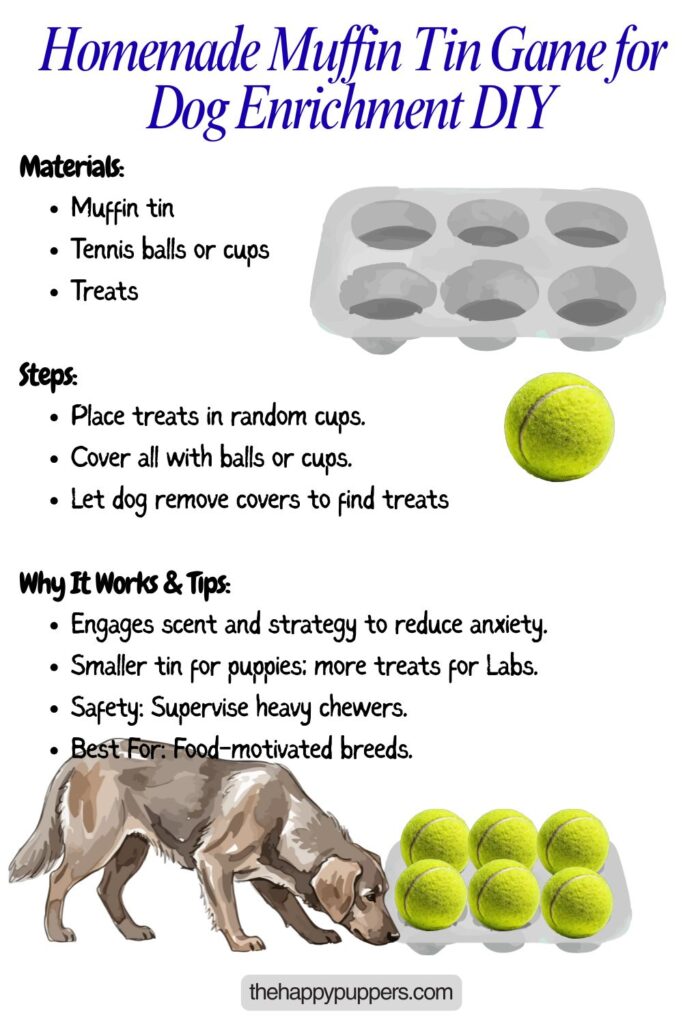
Homemade dog enrichment ideas use what you have around the house for mental stimulation for dogs DIY without spending a dime, focusing on simple setups that promote exploration and reward-based learning.
Materials: A muffin tin, tennis balls or small toys/cups, treats or kibble.
Steps:
- Place a small treat or piece of kibble in a few random cups of the muffin tin (start with 3-4 for beginners).
- Cover all the cups with tennis balls, small toys, or inverted cups to hide the treats.
- Set the tin on the floor and let your dog sniff around—encourage them to nudge or remove the covers to access the rewards.
- Praise them enthusiastically when they succeed, and reset for another round.
Why it works: This puzzle engages scent detection and strategic thinking, as your dog must use their nose to locate treats and paws to manipulate obstacles, mimicking natural foraging. It slows down fast eaters, reduces anxiety by providing a sense of accomplishment, and can improve focus—vets note it helps lower cortisol levels in stressed pups.
Adaptations and variations: For puppies, use a smaller tin or egg carton with fewer covers; for food-motivated breeds like Labs, fill more cups. Increase difficulty by using stickier treats or adding layers of paper. A fun twist: Freeze broth in the cups for a cooling summer version.
Safety tips: Supervise to ensure they don’t chew on the balls or tin; opt for rubber balls if your dog is a heavy chewer.
Zeus, my Lab mix, mastered this fast, reducing his evening zoomies and turning mealtime into an exciting brain workout.
Pin this article for later:
Brain Games for Dogs at Home
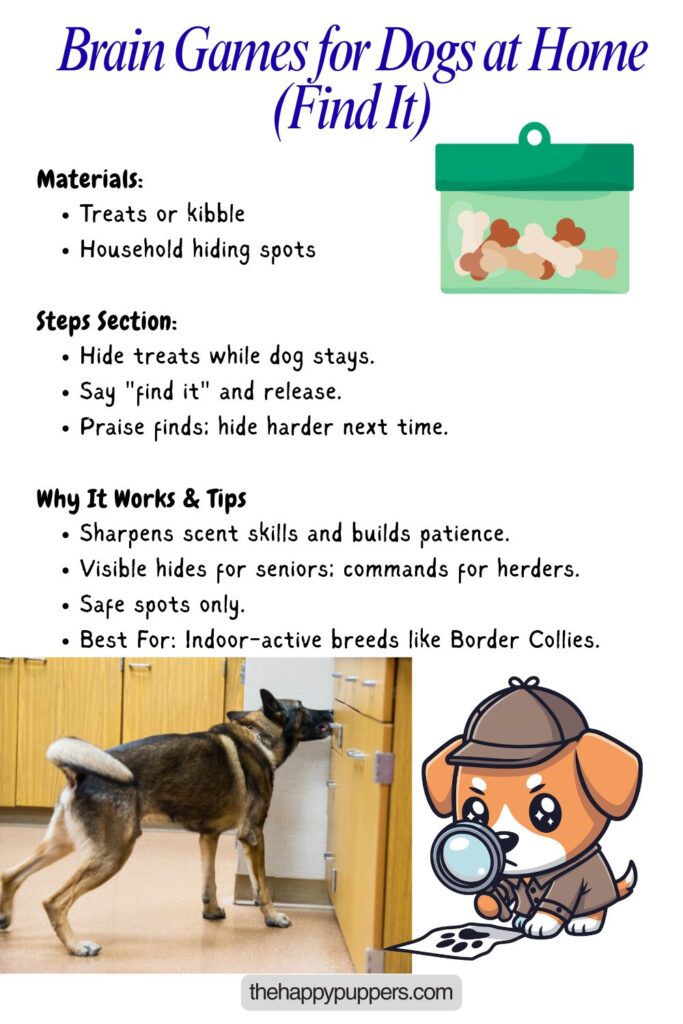
Brain games for dogs at home are ideal for mental stimulation for dogs DIY when you’re busy, offering quick, interactive ways to sharpen their mind without leaving the couch.
Materials: Treats or kibble, household hiding spots like furniture or rugs.
Steps:
- Ask your dog to “stay” or sit while you hide a few treats in easy-to-find spots around the room (let them watch at first).
- Give the cue “find it” and release them to search using their nose.
- Gradually hide treats in harder places, like under cushions, behind doors, or on low shelves.
- Reward with praise and repeat, expanding to multiple rooms as they improve.
Why it works: This scent game leverages your dog’s incredible sense of smell—up to 40 times stronger than humans—to boost dopamine and confidence, while teaching patience and recall. It’s great for reducing separation anxiety and destructive behaviors, as it satisfies their innate hunting drive.
Adaptations and variations: For herding breeds like Border Collies, add commands during the search; for seniors, keep hides low and visible. Outdoor version: Scatter in the yard for a “scavenger hunt.” Start with high-value treats for motivation.
Safety tips: Use dog-safe spots to avoid accidents; supervise if your dog tends to chew found items.
Personal tip: Alpha, my youngest, gets excited for this – it tires her out mentally without needing a long walk (Askavet).
Pin this article for later:
Dog Enrichment Activities DIY
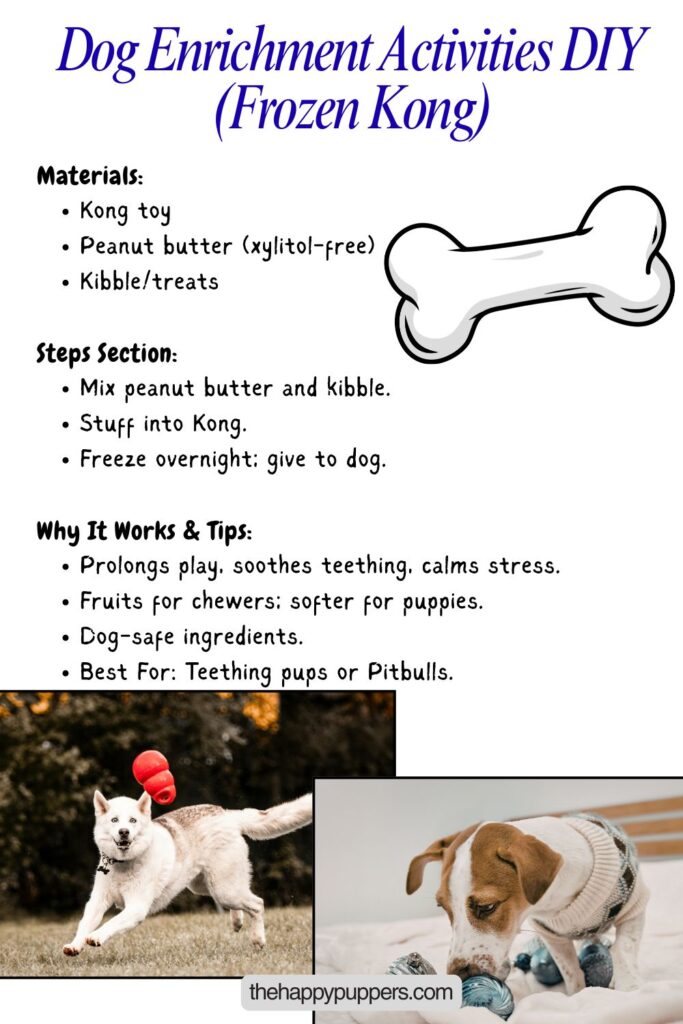
Dog enrichment activities DIY can be as simple as a frozen Kong stuffed with peanut butter and kibble, turning everyday feeding into a brain-boosting adventure.
Materials: A Kong toy or similar rubber chew, peanut butter (xylitol-free), kibble or treats, freezer.
Steps:
- Mix peanut butter with kibble or small treats to create a sticky filling.
- Stuff the mixture firmly into the Kong, leaving a bit of space at the top.
- Freeze overnight or for a few hours until solid.
- Give it to your dog and watch them lick, chew, and paw to extract the goodies.
Why it works: Prolonging eating time engages persistence and problem-solving, calming jittery dogs and reducing stress—ideal for teething pups as the cold soothes gums while tiring the brain more than a walk.
Adaptations and variations: For chewers like Pitbulls, add frozen fruits; for puppies, use softer fillings. Layer ingredients for graduated difficulty, or attach a rope for tossing.
Safety tips: Use dog-safe ingredients (no onions, chocolate); supervise to prevent over-chewing the toy.
This calmed Delta during thunderstorms, turning a scary time into a focused, rewarding activity. Food-based enrichment is a go-to for combining nutrition with mental health benefits (Just Food for Dogs, 2024).
Pin this article for later:
Indoor Mental Stimulation for Dogs
For apartment living, indoor mental stimulation for dogs keeps things contained and quiet, using fabric to create foraging challenges that hone their senses.
Materials: Fleece fabric or old towels/blankets, a rubber mat or cardboard base, treats.
Steps:
- Cut fleece or towels into 1-2 inch wide strips, about 6-12 inches long (aim for 100-200 strips for a full mat).
- Tie each strip through the holes of a rubber mat or poke holes in cardboard, knotting tightly to create a shaggy surface.
- Scatter treats or kibble among the strips.
- Let your dog forage by sniffing and pulling to find the hidden food.
Why it works: It mimics grass foraging, engaging scent work to lower anxiety and promote calm—perfect for preventing barking from boredom, with benefits like improved focus and reduced destructive habits.
Adaptations and variations: For small breeds like toy poodles, make a mini version; braid strips for a quicker towel alternative. Add scents like dried herbs for extra challenge.
Safety tips: Wash regularly; supervise to avoid swallowing fabric.
My cousin Millie uses this for her toy poodle – it prevents barking from boredom and keeps her pup happily occupied. Indoor setups are essential for pets in smaller spaces, promoting calm and focus (Mr and Mrs Pet, 2023).
PiPin this article for later:
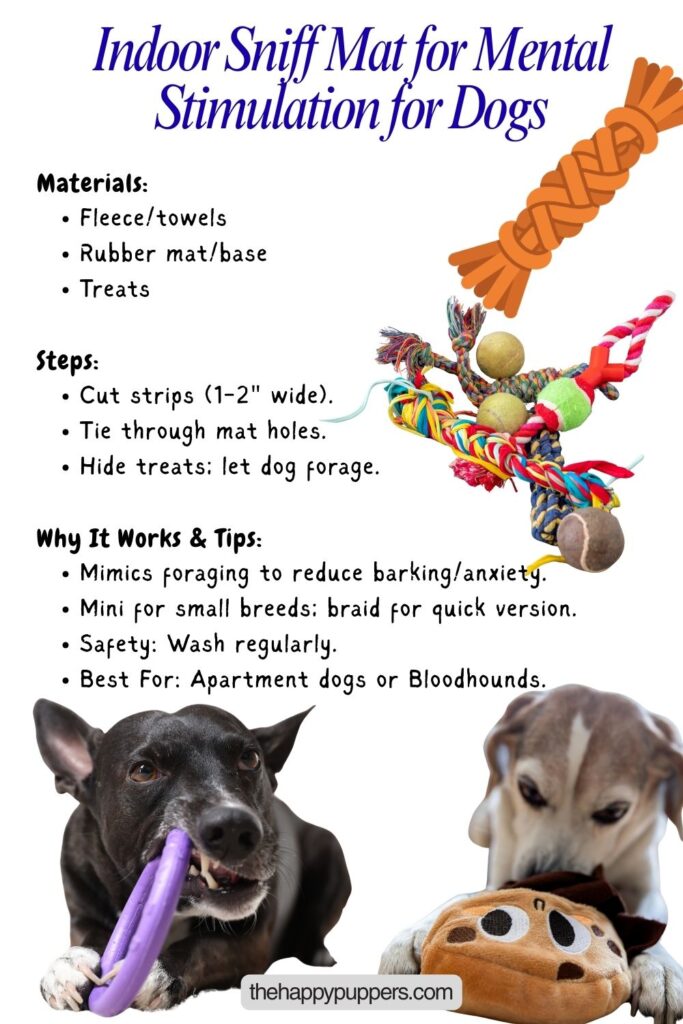
Cheap Dog Enrichment Ideas
Cheap dog enrichment ideas prove mental stimulation for dogs DIY doesn’t need fancy toys, with spinning dispensers that add movement to the mix.
Materials: Empty plastic bottle (clean, label removed), rope or string, treats, drill or knife for holes.
Steps:
- Drill small holes in the bottle sides (start large for ease).
- Fill with treats or kibble.
- Thread rope through the bottle neck and bottom, tying knots to secure.
- Hang at dog height or let them roll it on the ground; they spin or shake to dispense treats.
Why it works: Promotes physical manipulation and problem-solving, channeling energy to prevent frustration—great for energetic breeds, reducing behaviors like digging by satisfying curiosity.
Adaptations and variations: For terriers, hang higher; start full for easy wins. No-hang version: Just roll on floor.
Safety tips: Smooth edges; supervise to avoid plastic ingestion.
Under $5, and Zeus loves it for his food motivation, keeping him engaged without breaking the bank (The Grateful Pet).
Pin this article for later:
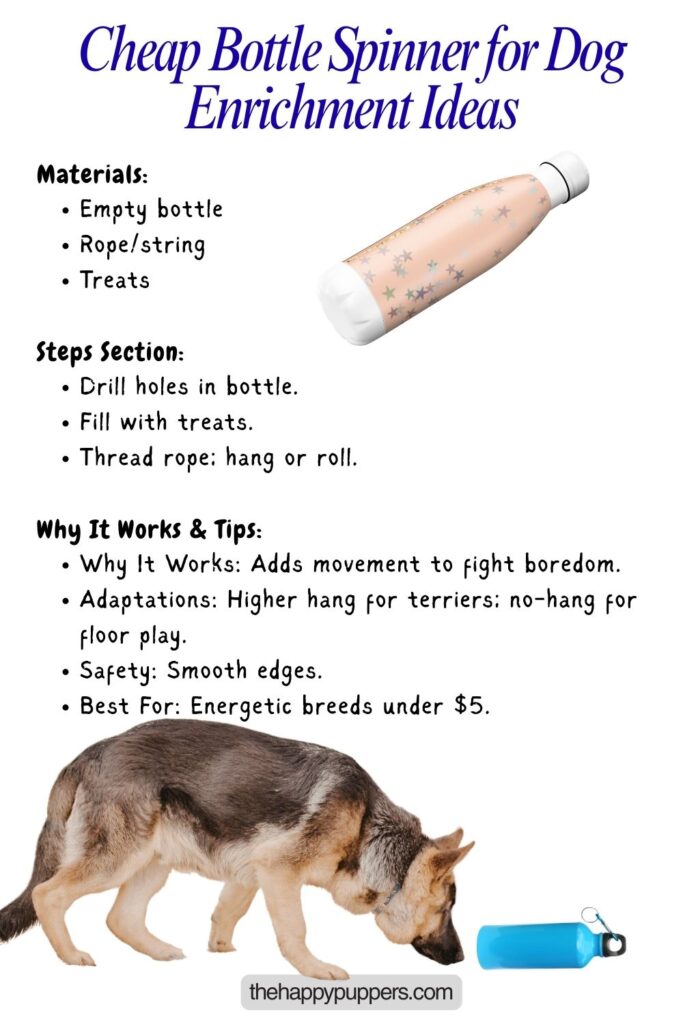
Dog Boredom Busters DIY
Dog boredom busters DIY are quick fixes for restless days, like unraveling rolls that provide instant engagement.
Materials: Old towel or blanket, treats or kibble.
Steps:
- Lay the towel flat and scatter treats across it.
- Roll it up tightly, enclosing the treats inside.
- Knot the ends loosely if needed for extra challenge.
- Give to your dog—they unroll or chew through to find the rewards.
Why it works: Encourages persistence and scent detection, mimicking burrowing instincts to alleviate boredom and build patience, cutting unwanted chewing by redirecting energy.
Adaptations and variations: For small breeds, use a kitchen towel; add newspaper for crunch. Freeze for longer play.
Safety tips: Supervise; wash fabric after use.
Alpha shredded one in excitement, but it beat chewing furniture, saving my couch (Gingrapp).
Pin this article for later:
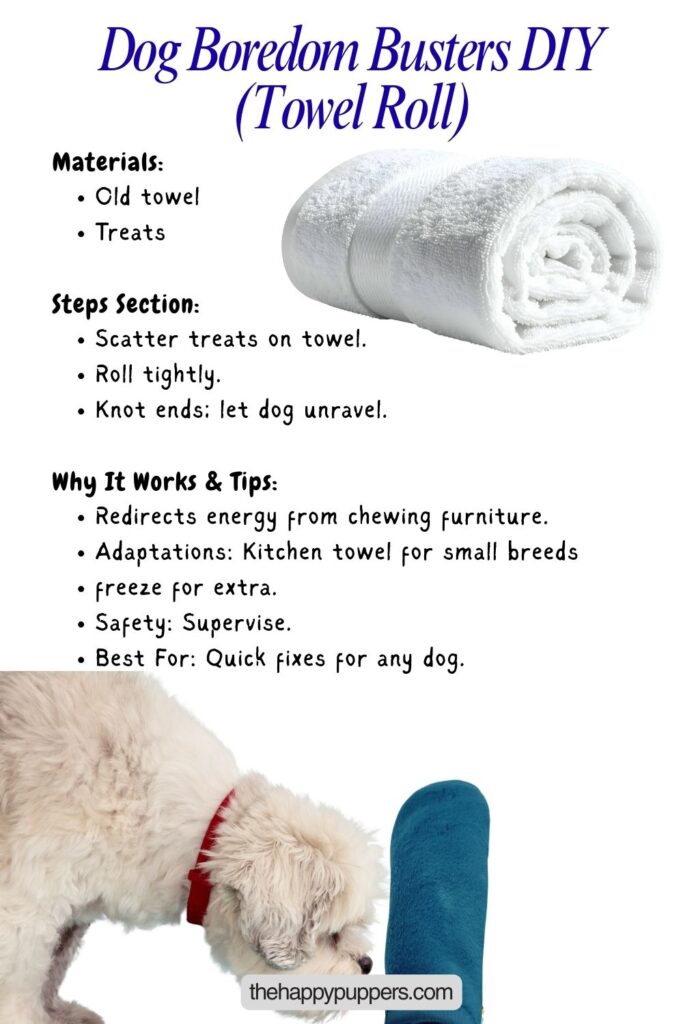
Puzzle Toys for Dogs Homemade
Puzzle toys for dogs homemade elevate mental stimulation for dogs DIY with layered challenges like mazes.
Materials: Cardboard box, treats, knife or scissors for cutting.
Steps:
- Cut various holes or flaps in the sides and top of the box.
- Place treats inside, optionally threading some through holes with string.
- Seal loosely if desired, and let your dog navigate by pawing, nosing, or tearing flaps.
- Start simple with open flaps, building to more sealed versions.
Why it works: Fosters exploration and strategic thinking, engaging multiple senses to boost cognitive health and slow age-related decline—perfect for intelligent breeds.
Adaptations and variations: For seniors, simplify with fewer holes; add fillers like paper for doodles. Stack boxes for advanced mazes.
Safety tips: Remove staples; supervise tearing.
For seniors: Simplify paths. Delta, at 7, still enjoys the challenge, keeping his mind sharp (AKC, 2023).
Pin this article for later:
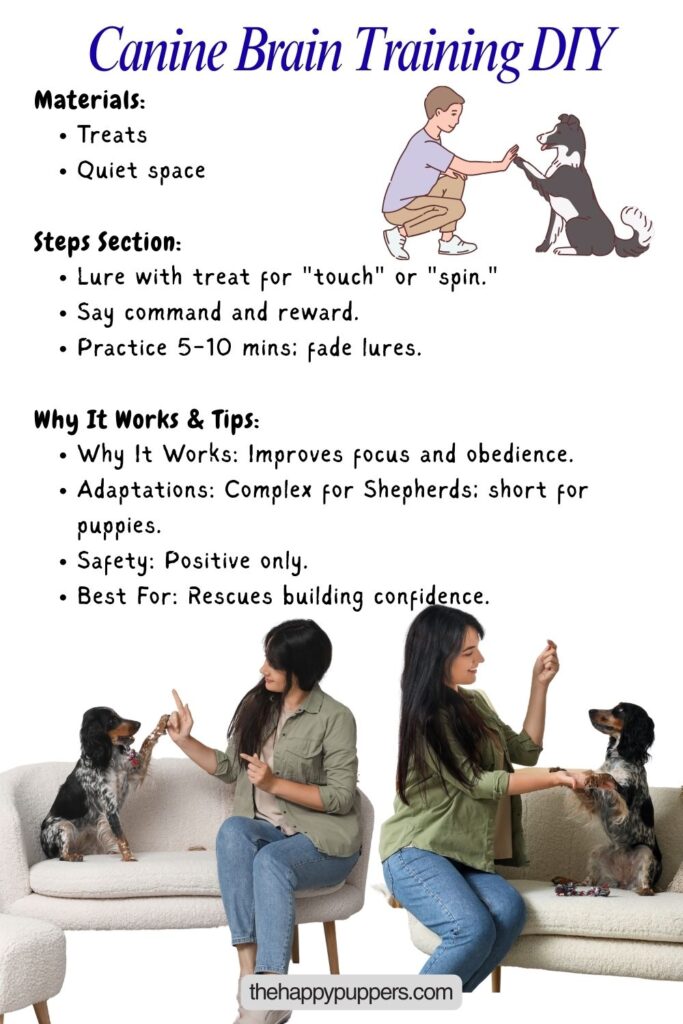
Canine Brain Training DIY
Canine brain training DIY focuses on commands for mental stimulation for dogs DIY, turning short sessions into obedience boosters.
Materials: Treats, quiet space.
Steps:
- Choose simple commands like “touch” (nose to hand) or “spin” (circle for treat).
- Use positive reinforcement: Lure with treat, say command, reward success.
- Practice in 5-10 minute sessions, 2-3 times daily.
- Gradually fade lures, adding distractions for mastery.
Why it works: Builds focus, patience, and confidence through learning, improving overall behavior and reducing stress—great for rescues building trust.
Adaptations and variations: For German Shepherds, add complex tricks; short bursts for puppies. Incorporate objects like naming toys.
Safety tips: Keep sessions positive; avoid frustration.
Millie’s poodle learned tricks fast, improving obedience and making playtime more interactive.
Pin this article for later:
Enrichment Games for Dogs at Home
Enrichment games for dogs at home like “which hand” – hide treat in fist, let dog choose—offer simple decision-making fun.
Materials: Treats.
Steps:
- Hold treats in both fists, show your dog.
- Hide one treat in a fist, extend both.
- Say “which one?” and let them nose or paw the correct hand.
- Reward immediately; shuffle for repeats.
Why it works: Enhances decision-making and memory, fostering quick thinking and bond-building through interaction—reduces loneliness-induced behaviors.
Adaptations and variations: For mixes, add more hands (family help); for rescues, start visible.
Safety tips: Gentle play only.
Zeus guesses right 70% of the time now, turning guesses into confident choices (Snowy River Doodle). Easy games like this are a staple in modern pet training for building quick decision-making (Modern Dog RI, 2025)
Mental Games for Bored Dogs
Mental games for bored dogs wrap up our list with variety, like the shell game for tracking skills.
Materials: 3 cups or bowls, treats.
Steps:
- Place a treat under one cup while your dog watches.
- Shuffle the cups slowly at first.
- Ask “find it” and let them indicate (nose or paw).
- Lift the chosen cup; reward if correct, show if wrong, and retry.
Why it works: Sharpens focus and memory, using visual tracking to combat boredom—engages shy dogs by building success-based confidence.
Adaptations and variations: For poodles, speed up shuffles; use more cups for challenge.
Safety tips: Non-breakable cups; positive reinforcement.
Perfect for rainy afternoons; keeps Alpha engaged without much setup (Canine Brain Games).
Comparison of DIY Mental Stimulation Ideas
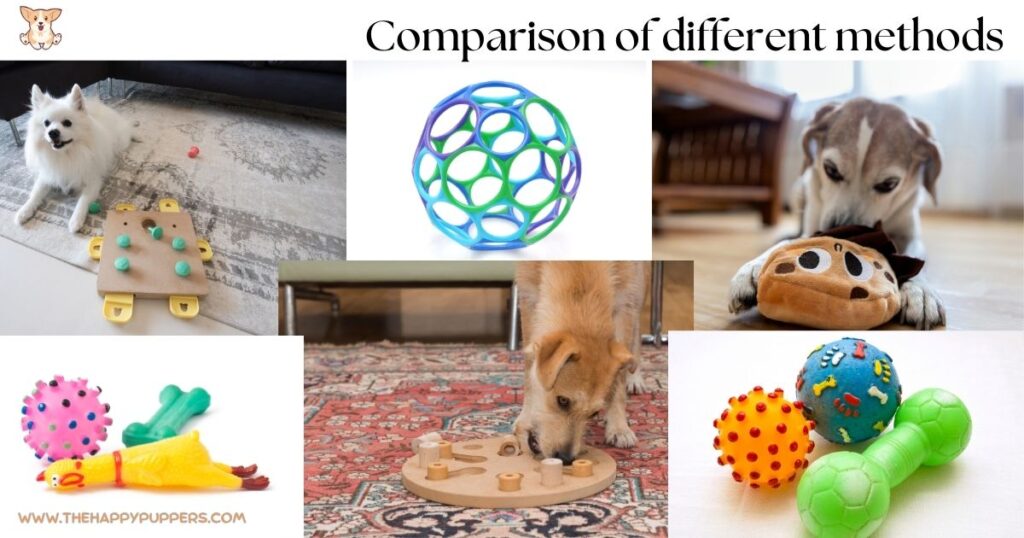
To help you choose the right activity for your pup, here’s a handy comparison table. It breaks down each idea by materials needed, prep time, difficulty level, and best-suited breeds or situations.
| Idea | Materials | Time | Difficulty | Best For |
|---|---|---|---|---|
| DIY Dog Puzzle Toys | Toilet paper rolls, treats, cardboard box | 5-10 min prep, 10-20 min play | Easy | Scent hounds like Beagles; all ages for problem-solving |
| Homemade Dog Enrichment Ideas (Muffin Tin) | Muffin tin, tennis balls, treats | 2-5 min prep, 10-15 min play | Easy | Puppies and food-motivated breeds like Labs |
| Brain Games for Dogs at Home (Find It) | Treats, household hiding spots | 1 min prep, 5-15 min play | Easy | Herding breeds like Border Collies; indoor-active dogs |
| Dog Enrichment Activities DIY (Frozen Kong) | Kong toy, peanut butter, kibble | 5 min prep + freeze time, 20-30 min play | Easy | Teething puppies or chewers like Pitbulls |
| Indoor Mental Stimulation for Dogs (Sniff Mat) | Fleece, rubber mat, treats | 10-15 min prep, 10-20 min play | Medium | Apartment dogs or scent breeds like Bloodhounds |
| Cheap Dog Enrichment Ideas (Bottle Spinner) | Empty bottle, rope, treats | 5 min prep, 10-15 min play | Easy | Energetic breeds like Terriers; budget-conscious owners |
| Dog Boredom Busters DIY (Towel Roll) | Towel, treats | 2 min prep, 5-10 min play | Easy | Small breeds or quick sessions for any dog |
| Puzzle Toys for Dogs Homemade (Cardboard Maze) | Cardboard box, treats | 10 min prep, 15-25 min play | Medium | Senior dogs or intelligent breeds like Poodles |
| Canine Brain Training DIY (Commands) | Treats | No prep, 5-10 min sessions | Medium | Obedience-focused breeds like German Shepherds |
| Enrichment Games for Dogs at Home (Which Hand) | Treats | 1 min prep, 5-10 min play | Easy | All breeds; building trust with rescues |
| Mental Games for Bored Dogs (Shell Game) | Cups, treats | 1 min prep, 5-15 min play | Easy | Toy breeds or decision-making for mixes |
Tips for Success and Safety
Start slow – 10-15 minutes to avoid overstimulation. Supervise to prevent choking. Rotate activities weekly. For breeds like herding dogs, add chasing elements; for hounds, more scent work. Always use non-toxic materials.
As a dog guardian myself, I know how handy it is to have quick references at your fingertips—especially when juggling busy days with your pup’s needs. That’s why I’ve created this free printable: Download Free DIY Mental Stimulation Guide PDF with checklists, packed with boredom signs to spot, a materials master list, and trackers to customize these ideas for your dog. It’s designed to complement the full mental stimulation for dogs DIY activities in this post, helping you stay organized and see real progress in reducing anxiety or destructive behaviors. Perfect for printing and pinning to your fridge or sharing with friends. Grab it now to make enrichment a breeze and keep your furry friend happier and healthier!
Real-Life Scenarios: How These Worked for My Dogs and Readers
Alpha was destructive after long days alone. Introducing DIY dog puzzle toys turned him into a calm explorer – no more ruined socks. A reader shared how brain games for dogs at home helped their rescue overcome anxiety, echoing my experience with Zeus during vet visits. Zeus has anxiety issues and takes a whiile to warm up to new people. Millie’s toy poodle, always yappy, quieted down with indoor mental stimulation for dogs. These aren’t just ideas; they’ve changed lives, including preventing boredom in senior pups like one reader’s 12-year-old Schnauzer (Dirty Dog Austin, 2024).
Exploring More on The Happy Puppers
At The Happy Puppers, I cover everything a dog parent needs to know—from training and psychology to health and beyond. Check out these six main hubs, each packed with practical tips, expert insights, and real-life stories to help you nurture a joyful bond with your pup.
DIY for Dogs
This hub is all about fun, hands-on projects you can do at home to enrich your dog’s life without breaking the bank. Think homemade toys, enrichment games, or simple setups to boost mental stimulation. It’s perfect for guardians who love getting creative to keep their pups engaged and happy.
Dog Health
Focused on preventive care, treatments, and overall wellness, this category dives into common health issues, vet advice, and how to spot early signs of trouble. From vaccinations to managing chronic conditions, it’s your go-to for keeping your dog thriving physically.
Dog Behaviors
Here, we decode those quirky habits and behaviors that make our dogs unique—from tail wags to whining. Drawing from canine psychology, we explore why they act the way they do and how to guide them positively. Ideal for understanding and addressing things like fear or excitement.
Dog Breeds
Explore the traits, needs, and fun facts about different breeds (and mixes like my Delta!). Whether you’re adopting or just curious, this hub helps match lifestyles to breeds and offers breed-specific tips on care, training, and health.
Dog Grooming
All about keeping your pup looking and feeling their best—from nail trims to coat care. We cover at-home routines, professional services, and how grooming impacts health and comfort, with gentle techniques for sensitive dogs.
Dog Nutrition
Nutrition is key to a happy, healthy dog! This hub breaks down balanced diets, treat ideas, supplements, and how food affects energy, mood, and immunity. We focus on age-specific, breed-tailored advice to fuel your pup right.
Conclusion
Tired of coming home to a bored, destructive pup? Transform your dog’s day with these mental stimulation for dogs DIY ideas—start with just one today and watch the zoomies turn into zen! For even more hands-on demos (like me showing Delta mastering a puzzle toy), head over to my YouTube channel, Shruti and Delta, where I share weekly videos on dog psychology, training tips, and real-life enrichment hacks straight from my home with Delta, Zeus, and Alpha.
Subscribe to my newsletter for exclusive freebies like printable enrichment checklists and breed-specific guides—plus, get notified about new posts to keep your furry friend thriving. Drop a comment: What’s your dog’s favorite boredom buster? Share your stories, and let’s build a community of happy, engaged pups together. Your input could inspire the next post—tag a friend who needs this!
(P.S. Pin these ideas on Pinterest for easy access—search “TheHappyPuppers” for more visual inspo!)

Frequently Asked Questions
Mental stimulation for dogs DIY involves homemade activities like puzzles, scent games, and training using household items. Start with simple ones like hiding treats, progress to complex like frozen toys. Incorporate daily for 15-30 minutes, adapting to your dog’s age and energy. Use safe materials, supervise, and rotate for freshness. This covers all aspects from basic to advanced, ensuring comprehensive brain engagement.
15 minutes of mental stimulation for dogs equals a short session of brain-teasing activities like puzzle toys or scent hunts, which can exhaust them more than physical play. It’s ideal for busy days, preventing boredom and promoting calm. Combine with walks for balance, and track improvements in behavior.
The 7 second rule for dogs suggests holding a new command or trick for 7 seconds before rewarding, building focus and patience. It’s part of positive training, enhancing mental stimulation for dogs DIY by encouraging self-control. Apply in games like “wait” for treats.
The 7 7 7 rule for dogs is a decompression guideline for rescues: 7 days to adjust to home, 7 weeks to learn routines, 7 months to fully bond. It ties into mental stimulation for dogs DIY by emphasizing gradual enrichment to build trust without overwhelm.
The 10 10 10 rule for dogs recommends 10 minutes of training, 10 of play, 10 of rest daily for balanced mental and physical health. It supports mental stimulation for dogs DIY by structuring sessions to avoid fatigue while maximizing engagement.
About the Author
Dr. Shruti Bhattacharya is the founder and guiding force behind The Happy Puppers, combining a Ph.D. in Immunology with decades of direct canine care experience. Her passion for the well-being of dogs has taken many forms:
- Academic & Scientific Rigor – Dr. Shruti applies a science-based approach to pet care, enriched by her training in immunology.
- Hands-On Street Work – Over the past 10+ years, she has personally cared for 30+ street dogs, tending to their health, training, and rehabilitation, even as she relocated and continued caregiving with 15 dogs, and currently supports 5 local neighborhood dogs outside her apartment.
- Instinctual Bond with Dogs – From stray pups to fostered companions, even strangers recognize her as a safe and trusted friend to dogs—drawn to her calm presence and empathy.
- Personal Pack – She’s the proud canine mom of Delta, a German Shepherd–Pitbull mix; Zeus, an energetic Labrador mix; and Alpha, a curious Indian pariah pup—each inspiring her mission through their daily lives.
Through The Happy Puppers, Dr. Shruti shares science-backed advice, empathetic insight, and evidence-based tips designed to empower dog guardians worldwide. The purpose of this is to blend real-world experience with academic expertise, helping every dog feel safe, loved, and thriving.

Follow me on:
Disclaimer
This content is for informational purposes only and not a substitute for professional veterinary or grooming advice. Consult a veterinarian for specific dietary concerns.
References
- Nonstop Dogwear, 2023. 7 DIY Dog Games.
- Askavet, 2025. 12 Mental Stimulation Ideas for Dogs – Vet-Approved Enrichment Guide.
- Pupford, 2024. DIY Enrichment.
- Gingrapp, 2023. Create DIY Dog Enrichment Activities Using Household Items.
- Snowy River Doodle, 2024. Dog Mental Stimulation.
- Canine Brain Games, 2023. DIY Dog Puzzle Toys.
- Dirty Dog Austin, 2024. Blog Post Title Three.
- The Grateful Pet, 2023. Keeping Your Dog Mentally Stimulated with DIY Toys Under SGD5.
- Morningside Veterinary, 2024. Canine Enrichment.
- AKC, 2023. Do-It-Yourself Cognitive Dog Toys for Home.
- Modern Dog RI, 2025. 5 Easy DIY Enrichment Games for Dogs.
- Just Food for Dogs, 2024. Dog Enrichment Ideas.
- Bark, 2023. 9 DIY Dog Enrichment Toys.
- Laylo Pets, 2024. Why Dog Enrichment Activities Go Beyond Just Physical Exercise.
- Mr and Mrs Pet, 2023. Indoor Enrichment and Mental Stimulation for Pets.
